
The regulation of social media in the EU is set to take a major step forward with a proposal to restrict access for children and teenagers. European Commission President Ursula von der Leyen announced on Wednesday during her State of the Union address to the European Parliament that children under 13 will not be allowed to access these platforms, while those under 15 will only be able to do so under parental supervision.
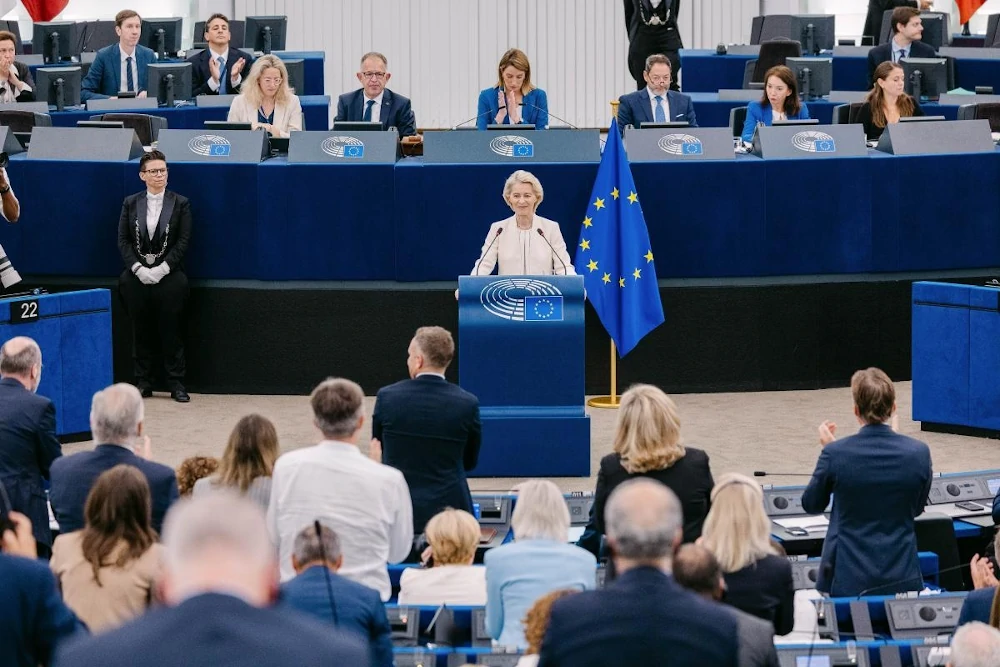
European Commission President Ursula von der Leyen during her State of the Union address to the European Parliament. Photo: © European Union, 202X, licensed under CC BY 4.0
The measures will form part of the new EU Kids Act, which the Commission will propose on Thursday. The initiative will establish different levels of protection according to age and require platforms to take greater responsibility for the safety of children and teenagers.
What the EU is proposing for children on social media
The proposal establishes three age groups:
- Under 13: they will not be allowed to use social media.
- Ages 13 to 14: they will only be able to have “mini accounts” created and supervised by their parents, with limited features and usage time.
- Ages 15 to 17: they will be able to have their own accounts, but platforms will be required to provide a safe design for minors.
“Every age has its own sensitivities and therefore each will have its own tailored level of protection”, Von der Leyen explained.
The EU Kids Act will therefore establish a minimum age for social media in the EU and a specific framework for social media for minors, with greater restrictions for younger users.
Platforms will have to prove they are safe
One of the main changes announced by Von der Leyen will be a reversal of the burden of proof. Platforms will have to demonstrate that their services are safe for children and teenagers.
The president argued that Europe has the power to ban social media for children and restrict certain features on these platforms. “We do not have to accept addictive features. We do not have to accept children being dragged towards increasingly extreme content”, she said.
She also warned about photographs of girls being used to generate sexualised images using artificial intelligence.
“This is not about our children accessing social media. It is about when and how we allow social media to access our children”, Von der Leyen said. “Europe has the power to act. We decide our rules, not Big Tech.”
Between four and six hours a day in front of screens
The European Commission president said young Europeans currently spend between four and six hours a day in front of screens. During her address, she warned about problems including sleep deprivation, anxiety and self-harm.
Von der Leyen recalled the case of Oléa, a 14-year-old girl who lived in Belgium and took her own life after experiencing online bullying. The president quoted her mother before Parliament: “I am convinced that without these omnipresent networks, my daughter would still be here. It is too much.”
To prepare the new measures for the protection of minors on social media, Von der Leyen explained that she convened a special panel of experts, spoke with young people and studied measures adopted in Australia and elsewhere where action has already been taken in this area.
The EU will also tackle addictive design
The regulation of social media in the EU forms part of broader action to address certain risks in the digital environment. Von der Leyen announced that the Commission will propose the Digital Fairness Act in the autumn, which will not be aimed solely at minors.
The future legislation will address issues including the addictive design of platforms, which the Commission president considers harmful to users of all ages.







Leave A Comment