
Hospital Universitari Son Espases has improved the outcomes of surgery for locally advanced colorectal cancer thanks to a 3D surgical planning tool that allows surgeons to assess the extent of tumours with greater precision before operating. Since its introduction in 2022, the technology has been used in 61 patients and has helped increase the chances of performing curative surgery, reduce recurrence rates and improve survival.
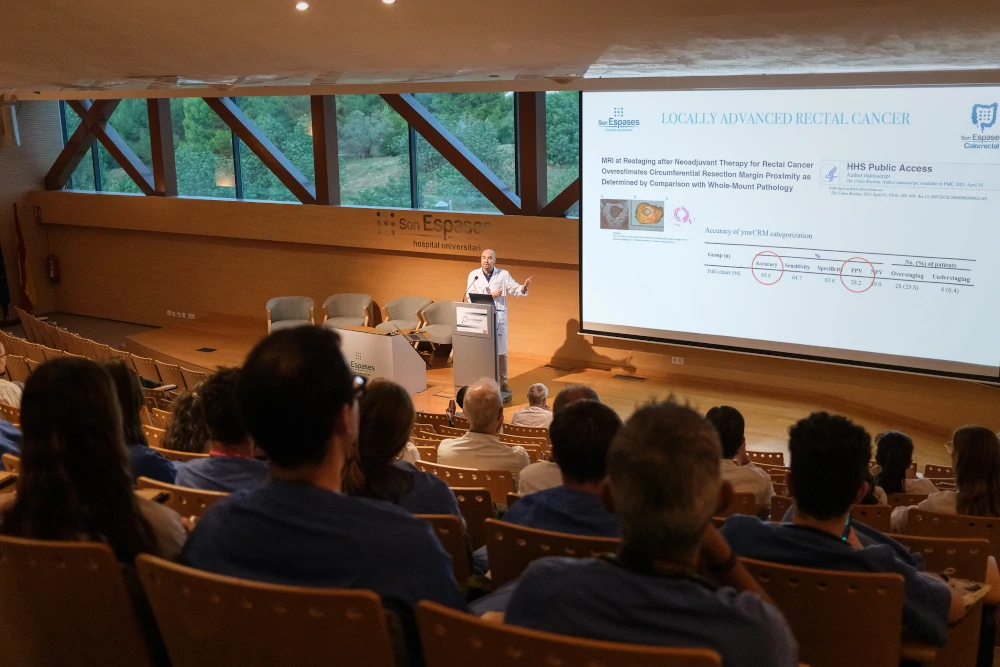
Dr Álvaro García Granero, a specialist in General and Digestive Surgery at Son Espases, during the presentation of the results of the 3D surgical planning tool. Photo: CAIB.
The results were presented by Dr Álvaro García Granero, a specialist in the General and Digestive Surgery Department at Son Espases, during a clinical session held at the hospital. The findings were also presented this year at the National Congress of the Spanish Association of Coloproctology and have been published in the scientific journal Annals of Surgery.
Curative surgery rates for rectal cancer rise from 48% to 92%
The most significant results concern patients with locally advanced rectal cancer. In these cases, the proportion of curative operations increased from 48% to 92% following the introduction of the 3D planning tool. In addition, local recurrence rates fell from 21% to 0%, while three-year recurrence-free survival rose from 79% to 100%.
Improvements have also been recorded among patients with locally advanced colon cancer. The overall recurrence rate fell from 34% to 8%, while three-year overall survival increased from 76% to 88%.
These figures reflect the outcomes observed among the patients studied and do not mean that the risk of recurrence has been eliminated in every case.
How the Son Espases 3D surgical planning tool works
The planning tool allows surgeons to reconstruct each patient’s anatomy in three dimensions using medical imaging scans. This enables them to identify more precisely the relationship between the tumour and nearby organs before entering the operating theatre.
The tool incorporates mathematical algorithms and artificial intelligence to detect possible tumour infiltration and plan particularly complex operations. It is especially useful in locally advanced colorectal cancers, when the tumour affects neighbouring structures.
This personalised planning can prevent the removal of organs that might have been considered affected using conventional techniques. During his presentation, García Granero described the case of a patient whose tumour had infiltrated the prostate and seminal vesicles. Four years after undergoing surgery with the help of this technology, the patient remains healthy.
The planning tool’s effectiveness has also been examined in a national multicentre study funded by the Spanish Association of Coloproctology and published in Annals of Surgery. According to its findings, 38% of surgeons changed their initially planned surgical technique after examining the three-dimensional reconstructions. In nine cases, curative surgery was possible without removing organs neighbouring the tumour.
Savings of €141,000 since 2022
Alongside its clinical benefits, the 3D planning tool has helped reduce healthcare costs. An economic assessment based on data from the Servei de Salut de les Illes Balears estimates that its use in the 61 patients operated on since 2022 has generated savings of €141,000 compared with conventional surgery.
According to the analysis, every euro invested in the technology has resulted in savings of €2.70.
Son Espases is also working on new applications for three-dimensional surgical planning. These include a collaboration with ADEMA to develop a pioneering 3D tactile simulator at international level, as well as projects incorporating augmented reality and three-dimensional reconstructions into robotic surgery.
The 3D images are also used to explain planned procedures to patients and help them participate in decisions about their treatment.
During his presentation, García Granero highlighted the importance of coordinated work between different healthcare professionals and the establishment of the Advanced Pelvic Oncological Surgery Committee at Son Espases. The hospital also plans to introduce a case manager role to improve coordination of care.




Leave A Comment