Echoes of war: the island imports more than 800,000 tonnes of food each year and has only a limited buffer if supplies are disrupted
Tensions in the Strait of Hormuz have highlighted the fragility of global maritime transport. In an island territory such as Mallorca, a scenario involving a disruption of supplies would have an almost immediate impact. “If not a single box were to arrive, we have resources to last between four and five days. After that, there would start to be some problems with perishable products, such as chicken, meat and fish, and a gradual loss of variety in the rest. But if there is no strawberry yoghurt, there will be peach,” explains Bartolomé Servera, president of the Association of Food, Beverage and Cleaning Distribution Companies.
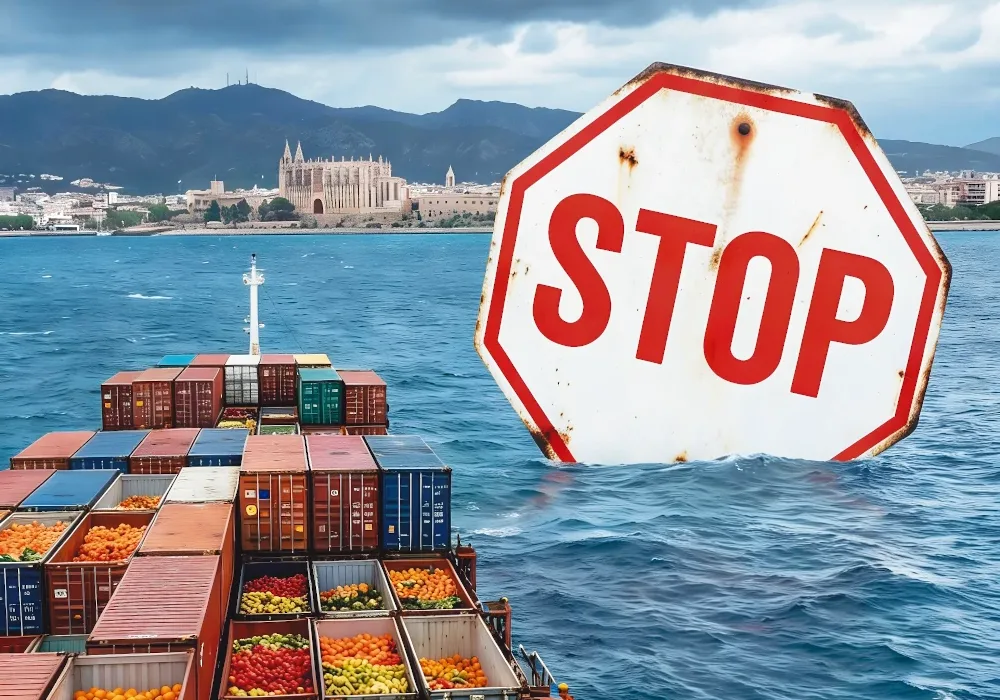
AI-generated image.
According to data from the Conselleria de Agricultura, around one million tonnes of agri-food products are consumed in Mallorca each year. With local production covering barely between 10% and 15% of demand, the bulk of consumption — more than 800,000 tonnes annually — depends on the constant arrival of goods from outside the island.
In this regard, the report Food Supply Chains in Mallorca, promoted by the Balearic Government, notes that self-sufficiency is limited to very few products: only nuts and potatoes reach full coverage levels. At a second level, vegetables, pulses and eggs show significant production, although insufficient to meet demand. Wine occupies an intermediate position, with a low level of self-sufficiency. Beyond that, dependence on external supply is very high or almost total for a large part of the basic basket. In some cases, such as oils, dairy products or rice, local production is virtually non-existent, while in others, such as meat, fish or milk, it barely accounts for a fraction of consumption.
“Today, any region in the world requires supplies from outside; no one is self-sufficient. A collapse here would be more serious because it is an island, but a shortage of certain products does not mean we would go without food,” qualifies Servera. The system has a certain buffer thanks to frozen products and the storage capacity of the distribution sector, with “more than 200,000 square metres of warehouses and cold storage facilities, which usually operate at 80% and reach 100% in peak season to guarantee supply,” he explains.
Food sovereignty
This hypothetical scenario may seem remote or even exaggerated, but in the view of Malén Mesquida, manager of the Associació Fora Vila — which brings together owners of estates, agricultural and livestock holdings and agrotourism businesses — it helps to highlight two “largely overlooked and alarming” realities: the fragility of the system and the island’s limited food sovereignty. “People are used to going to the supermarket and finding everything, but they do not stop to consider where it comes from or how it gets there. And with what is produced in Mallorca, one could survive, at most, for between 20 and 30 days, according to what experts in the sector have told me. But it is an issue that seems not to matter because it has never happened,” she notes. Mallorca se podría sobrevivir, como mucho, entre 20 y 30 días, según me han informado expertos del sector. Pero es un tema que parece no importar porque no ha pasado nunca”, señala.
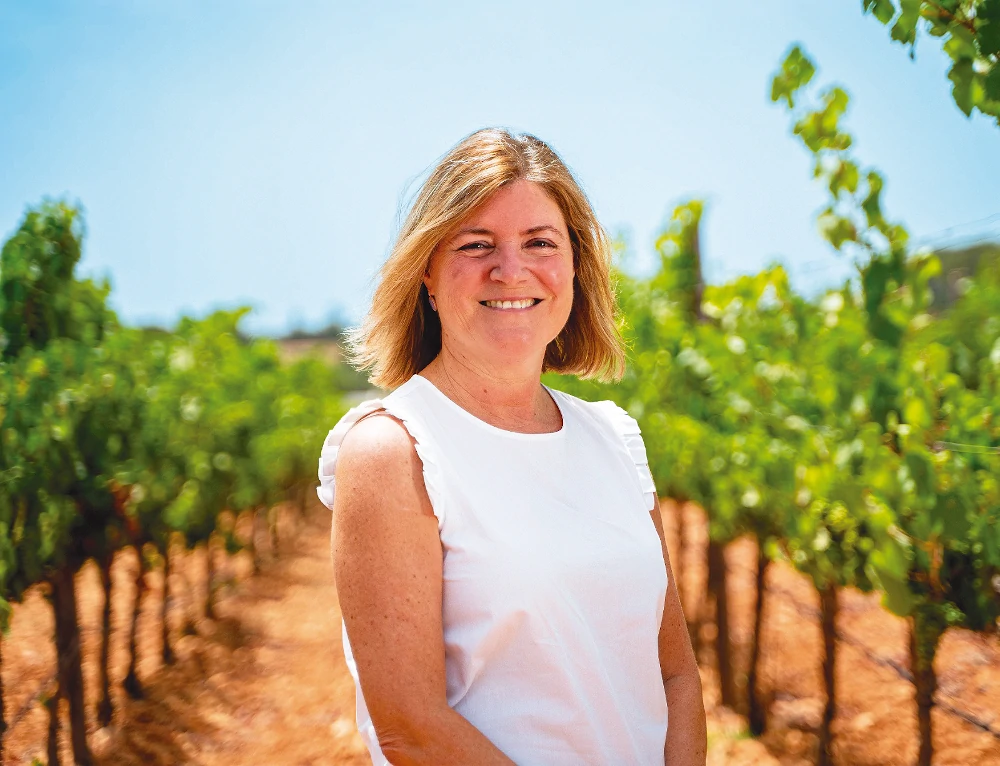
Malén Mesquida, manager of the Associació Fora Vila. Photo: M. M.
To external dependence is added the gradual loss of productive capacity, as reflected in the recent closures of the dairy company Agama and the potato cooperative s’Esplet in sa Pobla. A process that, far from being corrected, feeds on itself: as local holdings disappear, the need to import increases. “It’s a vicious circle,” Mesquida sums up.
Several factors converge behind this dynamic. “It’s not that there is no milk in Mallorca, it’s that competing with what comes from outside is very difficult. The quality is excellent, but the problem is the price,” she notes. The same logic is repeated in other sectors: “Extraordinary wines are produced here, but everything else — the bottles, the cork, the labels — comes from outside and makes the product more expensive.”
Added to this is the cost of land, shaped by speculation and urban pressure, as well as the lack of measures to offset insularity and facilitate agricultural activity. “The easiest thing is to sell or repurpose the land; the difficult part is making it profitable. With support for the primary sector, we could reach 50% or 60% self-sufficiency,” she concludes.




Leave A Comment