
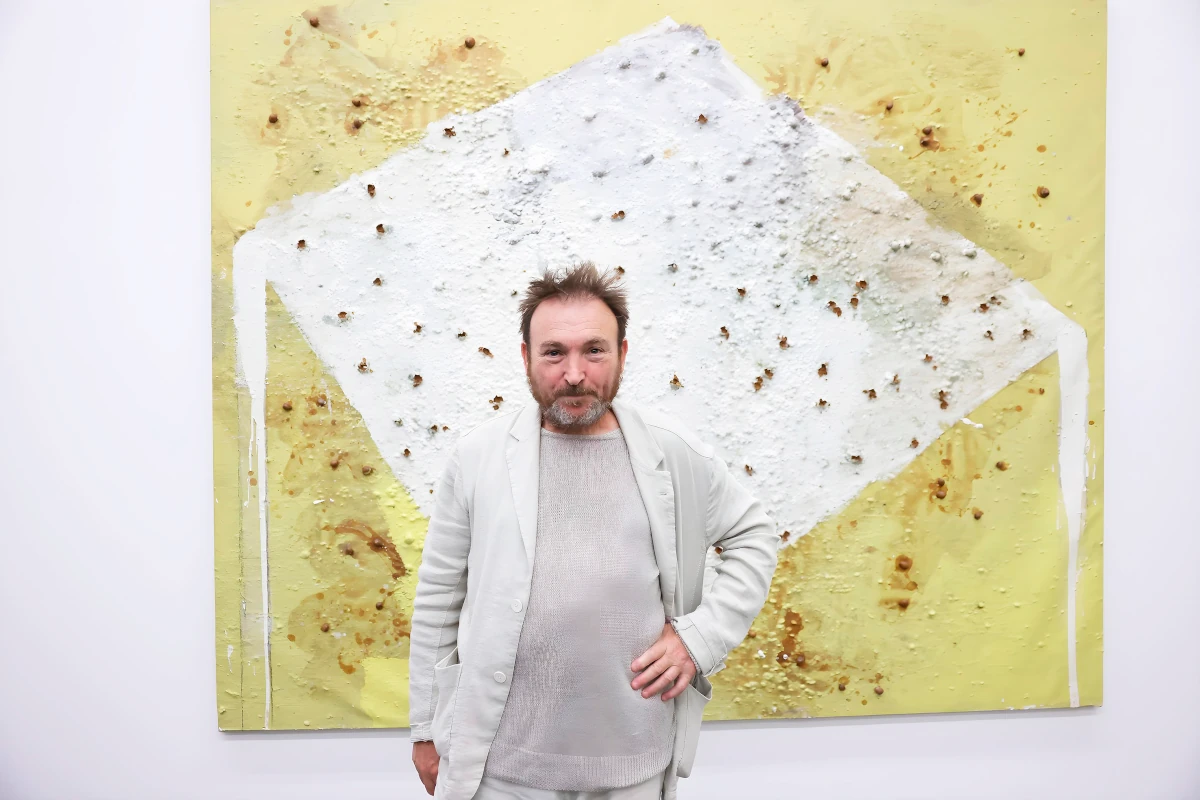
The artist during the opening of the exhibition “Vida y muerte” in Duisburg, Germany. Photo: Govern IB.
To approach the work of Miquel Barceló is to do so with the fear of diminishing the vast artistic universe of its creator. His entire body of work can be understood as a visual chain linked to a career marked by moments of great artistic impact.
Biel Amer. Palma.
It is easy to follow Miquel Barceló’s itinerary; what is considerably more difficult is to trace that artistic and personal journey. In his extensive De la meva vida, an autobiographical account, he recalls how he had a long and very rich childhood, and highlights how the smell of oil paint permeates his senses and his skin, close to the sea or submerged while covered in traces of paint.
Barceló revisits his entire family saga, established in Mallorca since the 13th century, and remembers several ancestors who were also named Miquel Barceló: one a sculptor, another a historian and writer. “Painting, swimming, reading. That is what I have always done,” he states with the certainty and conviction of someone who has known since childhood that his life would be surrounded by paintings and drawings, by the sea and by books. Yet writing would always remain as close to painting as the pencil or the brush. “I write because I have nothing to read,” he says — he writes — in Gao, Mali, in May 1988, during his first stay on African soil, his other earthly anchor.
His impeccable artistic career is marked by major projects undertaken with absolute fidelity to the visual work. His first great support as a painter came from his mother. She was the one who gave him the easel and his first tubes of oil paint, also allowing him to occupy an upper floor of the house to set up his first studio there. The artist himself recalls with emotion when his mother exchanged painting for embroidery, a gesture in which the artist’s future path can already be glimpsed. Together they even created works that constitute a family legacy never exhibited.
In 1982, his international breakthrough began with his participation in Documenta VII in Kassel. Alongside Basquiat and Haring — both of whom would die years later — he formed part of a trio of young promises whose momentum helped reveal the changes that were approaching in contemporary art.
The editor and writer Pepe Ribas, founder of the magazine Ajoblanco, published an extensive interview with Miquel Barceló in 1993. Richly documented with photographic material by Jordi Esteva, it revealed essential aspects of his artistic and personal life from his refuge-house-studio in Cap Farrutx. This was a vital moment moving between Mallorca, Mali and Paris, his three cardinal points, those that sustain both his emotional stability and the sources of inspiration that propel his creativity. “I have always tended to use what I have around me,” he replies when asked about the importance of contact with these places and their influence.
His life is already full of comings and goings, exhibitions, openings and social events. Although he has never had much of a social life, he does acknowledge the impact of meeting Andy Warhol, both because of his artistic ascendancy and because of the Velvet Underground.
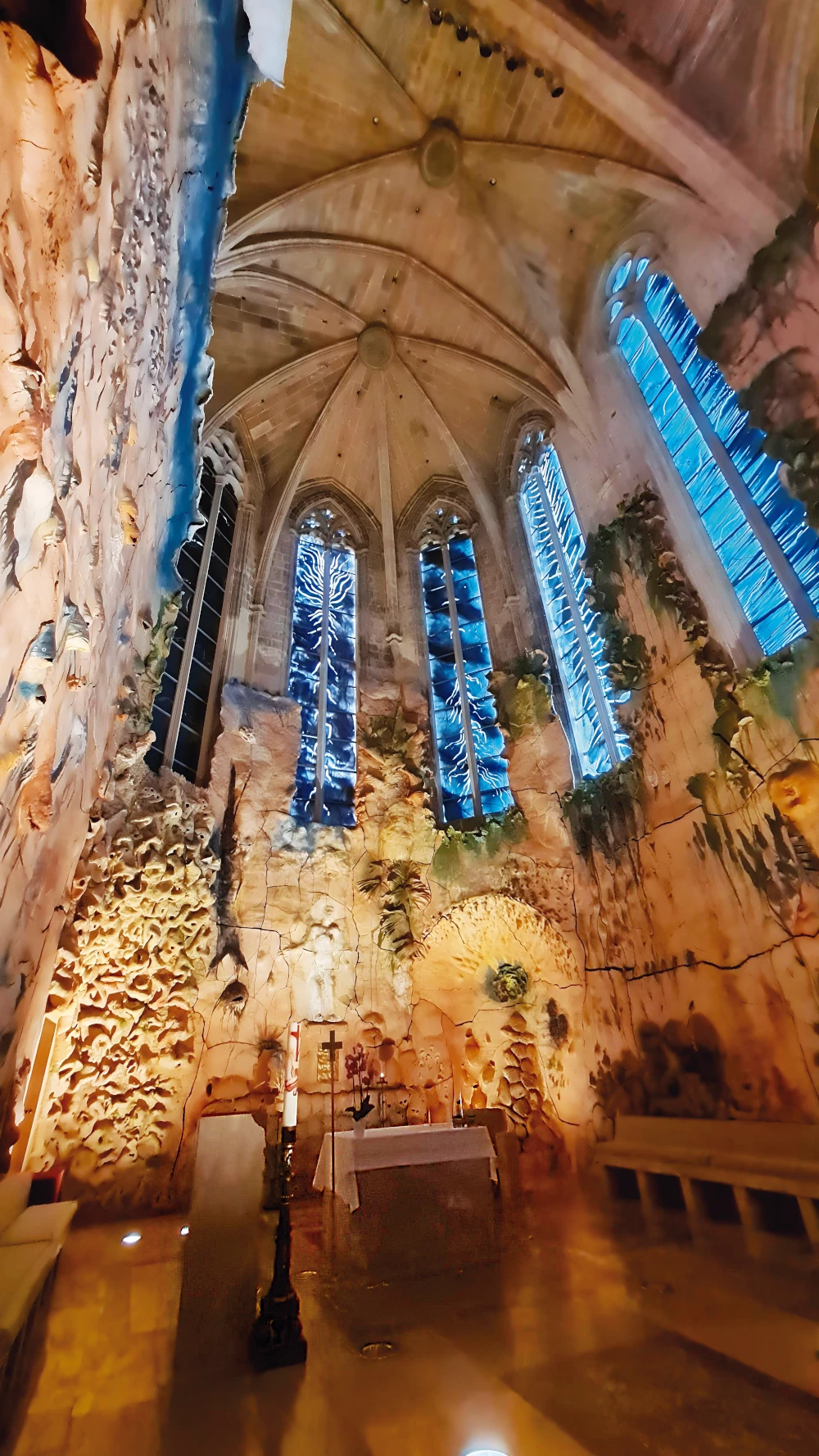
Miquel Barceló’s intervention in the Chapel
of the Blessed Sacrament in Mallorca Cathedral. Photo: Raúl Beltrán.
In 2000, coinciding with his appointment as doctor honoris causa, came the commission to carry out an intervention in the Chapel of the Blessed Sacrament in La Seu, Mallorca Cathedral. The proposal came from the UIB, the University of the Balearic Islands, and was enthusiastically welcomed by the then Bishop of Mallorca, Teodor Úbeda. The project, inspired by the multiplication of the loaves and fishes, was to cover the 300-square-metre chapel.
Years of work, comings and goings, negative comments, pressure and misinformation led to the inauguration of the monumental work in 2007. Today, the cathedral is one of the most visited in the country, with well over one million people entering the Gothic monument, including access to the chapel transformed by Miquel Barceló.
“In Africa, at first, I made plaster sculptures when it was too windy to paint… No one uses plaster there; clay is the traditional material.” From there came his skill in the use of that material, not only recurring in the cathedral project, but also in his artistic work with ceramics.
This is also shown in the artistic-theatrical intervention at sa Llonja with the performance Paso doble, an exercise in which Barceló and the choreographer Josef Nadj represented the construction of an artwork through clay.
A new international commission opened another controversy around the artist. Unmoved by these disputes, more political than artistic, Barceló set out to modify the dome of the meeting room at the Palace of Nations of the UN in Geneva, inaugurated in 2008. After months of tests, he managed to fill the ceiling with his mythical dripping, inspired by the stalactites of Mallorcan caves. “Spitting the paint. Painting the ceiling and provoking a rain of paint,” as he put it.
The artistic life of Miquel Barceló is contained in numerous editorial publications and catalogues of his work. Notable among them are L’univers artístic de Miquel Barceló, by Catalina Cantarellas, published by the UIB in 2003; A mitad del camino de la vida, by Dore Ashton, published by Galaxia Gutenberg in 2008; as well as writings and drawings by the artist himself, including Quaderns d’Àfrica, published by Galaxia Gutenberg in 2004, and De la meva vida, published by Galaxia Gutenberg in 2024. Also indispensable are El mar de Barceló and Mar de fang, documentaries by Agustí Torres.




Leave A Comment