
The second ring road in Palma will have a planned investment of €350 million, with construction expected to begin between late 2026 and early 2027. The project will connect the Llucmajor motorway (Ma-19) with the Inca motorway (Ma-13) and divert some of the vehicles currently using Palma’s Vía de Cintura ring road.
Balearic Government President Marga Prohens and Consell de Mallorca President Llorenç Galmés presented the project for section I of Palma’s second ring road on Wednesday. The project will be carried out in two phases and its main objectives are to reduce traffic in Palma and improve access to the city, particularly at some of the points where traffic congestion is most severe.
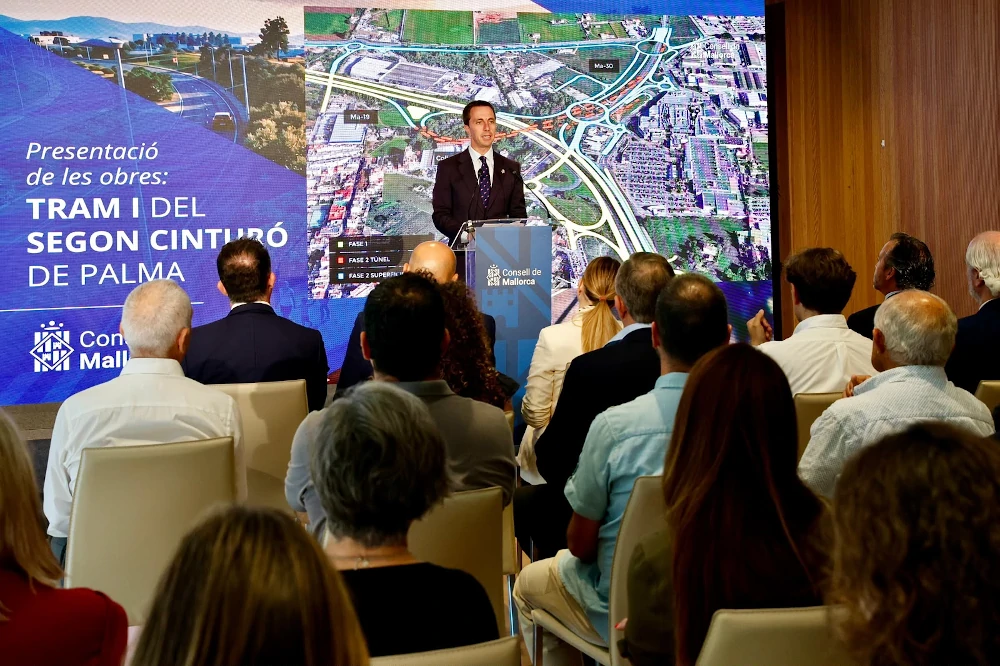
Consell de Mallorca President Llorenç Galmés during the presentation of the works for section I of Palma’s second ring road. Photo: CAIB.
Palma’s Vía de Cintura currently carries an average of around 185,000 vehicles a day. The new infrastructure will make use of sections of the second ring road that have already been built to create a connection between the Ma-19 and Ma-13, allowing drivers to avoid the Vía de Cintura on certain journeys.
Two phases to build section I of Palma’s second ring road
Construction of Palma’s second ring road will be divided into two major phases. The first will have a budget of €90 million and will focus on the connection with the Llucmajor motorway. The second will have a budget of €260 million and will include the construction of an underground section.
The first phase includes a new junction from the Llucmajor motorway near Mercapalma. Work will also be carried out on the junction serving the shopping centres and access to Coll d’en Rabassa, one of the areas with the greatest traffic problems in this part of Palma.
The project will move the road further away from homes on Carrer Cardenal Rossell in Coll d’en Rabassa. Services and utilities running to the airport that currently pass through this area will also be reorganised.
A one-kilometre tunnel on Palma’s second ring road
One of the main elements of the second phase will be the construction of a tunnel approximately one kilometre long. The aim of the underground section is to reduce the infrastructure’s visual impact and improve road safety.
A large boulevard and several pedestrian and cycle routes are planned above the tunnel. These spaces will improve connections between Coll d’en Rabassa, Son Ferriol, the commercial and industrial areas and Palma.
The project will also reserve space for a future stop on the rail connection towards the Migjorn area of Mallorca, allowing it to be integrated with plans for new public transport infrastructure.
An alternative to ease congestion on Palma’s Vía de Cintura
The new section aims to alleviate one of the city’s main mobility problems: congestion on Palma’s Vía de Cintura and the roads into Palma. By connecting the Llucmajor and Inca motorways, some traffic will be able to make the journey without using the existing ring road.
Prohens said the aim is to improve existing infrastructure and tackle the points that cause the greatest traffic problems. “We cannot and do not want to accept as normal the traffic jams that people suffer every day. We cannot resign ourselves to congestion that has become increasingly frequent on our road network in recent years”, she said.
The president said the project forms part of a mobility policy based on three areas: strengthening public transport in Mallorca, reducing the pressure of vehicles on the roads and improving road infrastructure.
In this latter area, the Balearic Government and Consell have a €30 million agreement covering work on 17 pieces of infrastructure across Mallorca’s road network, with projects aimed at improving access to Palma, road safety and traffic flow, as well as incorporating new pedestrian and cycle routes.
Public transport and vehicle regulation in Mallorca
The Balearic Government is linking the new road infrastructure with other measures to reduce congestion. These include strengthening the TIB intercity bus network and increasing train and metro frequencies during peak hours.
Work is also under way on new rail connections, including the Llucmajor and Alcúdia railway lines, the extension of the metro to Son Espases and rail projects towards Artà and Capdepera.
Another area of action is reducing the pressure of vehicles on Mallorca’s roads. The Consell has commissioned a carrying-capacity study to analyse traffic pressure and consider measures to regulate the entry of vehicles and the rental car fleet.
Galmés said that section I of the second ring road is a project that has been called for for years and highlighted the cooperation between the Consell and the Balearic Government to move forward with its funding and implementation.




Leave A Comment