
The city of Palma has incorporated, as of this Thursday, a new cultural landmark into its urban landscape. The mayor, Jaime Martínez Llabrés, presided over the inauguration of the sculpture by French artist Bernar Venet, located on the Façana Marítima, just a short distance from the Palau de Congressos de Palma.
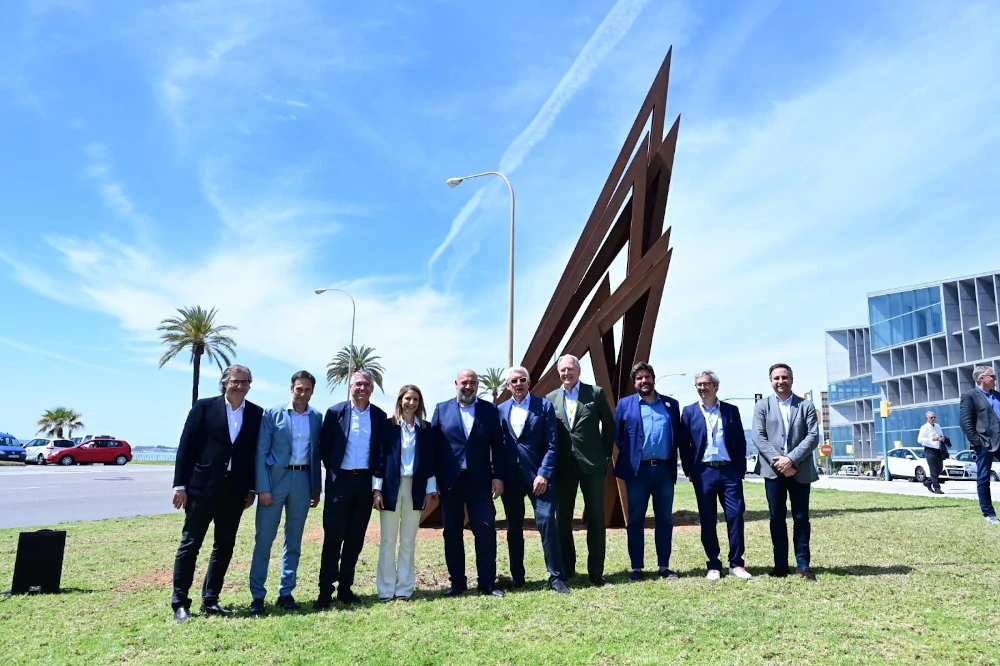
Authorities during the inauguration of Bernar Venet’s sculpture on Palma’s seafront. Photo: Ajuntament de Palma.
The piece, entitled 9 Acute Uneven Angles, is presented as a structure of striking visual power, marked by a constant tension between its elements. With no apparent hierarchy and a balance that seems to defy gravity, the work establishes a direct dialogue with the open surroundings of Palma’s seafront.
During the event, Martínez Llabrés said that the city is welcoming “an immeasurable work of art that further enriches the image of the Façana Marítima, a gateway and welcome point to Palma”, underlining the symbolic value of this addition to the public space.
Contemporary art at one of Palma’s finest cultural moments
The inauguration has coincided with the opening of the first edition of Art Cologne Mallorca, which is running until 12 April and places the city in the international spotlight of contemporary art.
The mayor stressed that Palma is going through “one of the finest moments in its history” in cultural terms, with an unprecedented concentration of internationally significant events and the growing presence of renowned creators who are choosing the city as a platform for their artistic proposals.
The event was attended by institutional representatives from the Government of the Balearic Islands and the Council of Mallorca, as well as figures from the cultural sector and organisations linked to the fair, including the Stiftung für Kunst und Kultur, Koelnmesse and Art Palma Contemporani.
Bernar Venet, from concept to urban space
Born in France in 1941, Venet is regarded as a key figure in the evolution of conceptual art since the late 20th century. His career began in the 1960s, closely linked to mathematical systems and analytical structures that blurred the boundaries between art and knowledge.
In the following decade, he transferred this thinking into three-dimensional space, creating sculptures based on essential geometric elements such as lines, arcs and angles. Although his work has often been associated with minimalism, his approach goes beyond that definition by incorporating a conceptual dimension that transforms mathematical logic into spatial experience.
Throughout his career, he has created numerous monumental works installed in cities across Europe, Asia and the United States, establishing himself as one of the leading figures in the integration of contemporary art into public space.




Leave A Comment