
High temperatures have caused 2,264 deaths in the Balearic Islands since 2018, most of them due to the worsening of pre-existing conditions in chronically ill patients
In summer, heat can shift from being a simple nuisance to a serious threat to health. Prolonged exposure or physical exertion during periods of high temperatures can trigger heatstroke, which often presents with intense fatigue, weakness or muscle cramps and may progress to loss of consciousness, seizures or even coma, multi-organ failure and death. “When a certain body temperature is exceeded, our ability to regulate heat fails and levels are reached that already cause direct damage to the brain and other organs,” explains Dr Javier Murillas, Head of the Internal Medicine Department at Hospital Universitari Son Espases.
Since 2004, the Directorate General for Public Health has recorded 182 alerts, 59 confirmed cases and 10 deaths from this cause in the Balearic Islands. These are, without doubt, the most extreme and visible cases, but the real impact of heat is far greater and, above all, less apparent. “Deaths from heatstroke are only the tip of the iceberg,” warns Murillas.
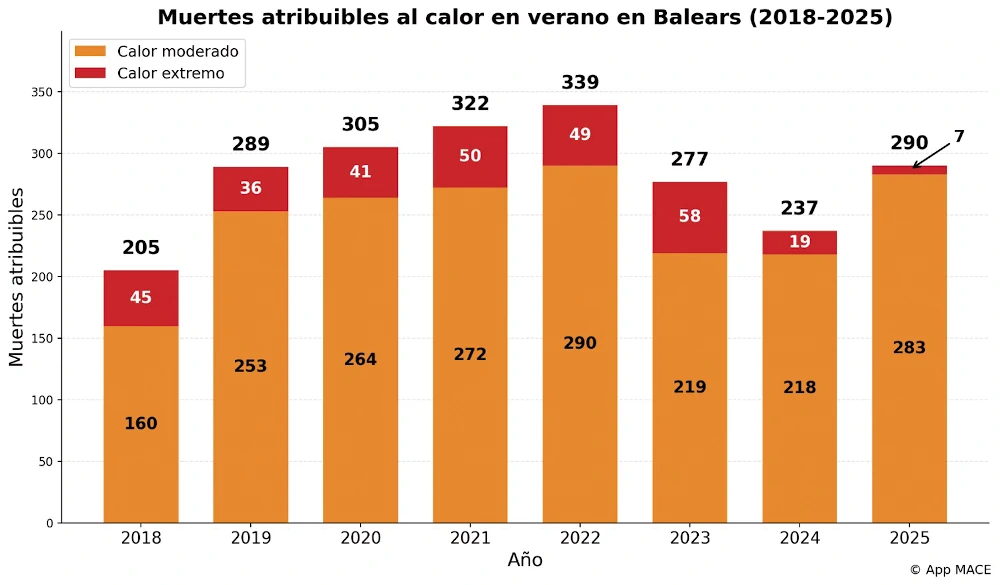
In fact, the Mortality Attributable to Heat in Spain (MACE) application has recorded 2,264 deaths linked to high temperatures in the islands during summer — between June and mid-September — since 2018, with a peak of 339 deaths in 2022, precisely the hottest year in Spain since 1961, according to the State Meteorological Agency (Aemet). “During the hot months we see more admissions for stroke, kidney failure, dehydration or thromboembolic events, which are effects caused by heat on pre-existing conditions, but not heatstroke,” he notes. In particular, the study Effect of Extreme Heatwaves on Morbidity and Hospital Admissions in a Western Mediterranean City, in which Murillas himself takes part, shows that hospital admissions increase by 6% and emergency admissions by 12%, with more pronounced rises in stroke (+26%) and acute kidney injury (+67%).
The body has two mechanisms to dissipate heat: sweating, which allows temperature to be released as sweat evaporates from the skin, and vasodilation, which causes blood vessels to widen so that a greater volume of blood is exposed to the air, facilitating its cooling. “In heatstroke, the ability to activate these physiological mechanisms is lost, but the number of deaths is very small. Heat-related mortality is much higher due to other, more common effects that affect far more people,” notes Murillas.
“Psychiatric conditions that require certain medications can reduce the body’s ability to respond to heat, and patients with complex chronic illnesses, especially respiratory or cardiovascular diseases, as well as obesity, are at greater risk, because heat can trigger the decompensation of their conditions and worsen them, which increases the likelihood of complications. That is why there are so many deaths during heatwaves,” he states.
In addition to people with chronic illnesses and psychiatric disorders, there are other particularly vulnerable groups. “Children, older people and those with neurodegenerative diseases are at greater risk, because in many cases they cannot protect themselves from the heat or do not adequately perceive the need to stay hydrated,” explains Murillas. This also applies to people with reduced mobility or dependency, who require support to remain in cool environments.
Social factors
The impact of heat on health does not depend solely on medical history, age and temperature, but also on people’s capacity to adapt. “There are significant differences depending on acclimatisation: in some areas, the temperature at which mortality begins to rise is around 24 degrees, while in others it is 30 degrees. It largely depends on how well people are adapted to their environment,” explains Murillas.
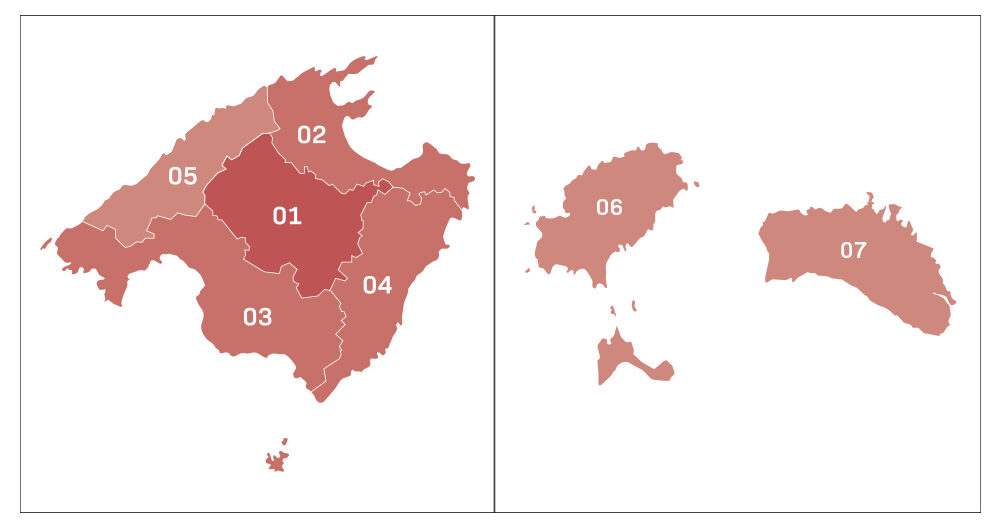
Heat mortality thresholds in Spain by isoclimatic zone. Each area has a different temperature above which the risk of death increases, reflecting the influence of factors such as population age, socio-economic conditions, urban or rural environments, housing quality and access to healthcare services. 01. Inland Mallorca: 35.9ºC | 02. North and north-east Mallorca: 34.8ºC | 03. South Mallorca: 34.4ºC | 04. Llevant: 34.3ºC | 05. Serra de Tramuntana: 33.9ºC | 06. Ibiza and Formentera: 33.1ºC | 07. Menorca: 32.2ºC. Source: Carlos III Health Institute and the Ministry of Science, Innovation and Universities.
Beyond clinical and climatic factors, the impact of heat is also shaped by social conditions. “Having a lower income, living in neighbourhoods with fewer green spaces or in homes built before insulation standards significantly increases the risk,” notes Murillas. “If you are unable to cool your home or move to cooler spaces, such as parks or climate shelters, you are more likely to be affected. It is not only a medical issue, it is also a social one, and both are equally important,” the doctor emphasises.
Added to this is direct exposure for work-related reasons. “People who work outdoors or carry out physical effort during the hours of maximum sun exposure are more exposed to heatstroke,” notes the specialist, who stresses the importance of companies adapting activity to climatic conditions, especially during the hours of peak sun exposure, as set out in Royal Decree-law 4/2023. Sectors such as construction, agriculture and hospitality face a higher risk during heatwave episodes.

Dr Javier Murillas. Photo: HUSE.
Forecasts for this summer point to higher-than-usual temperatures. Aemet models place the Balearic Islands in the warmest tercile, with the possible influence of “El Niño” intensifying heat episodes. In addition, an increase in tropical nights is expected, with minimum temperatures above 22 degrees, and during heatwaves temperatures may exceed 40 degrees inland in Mallorca, a scenario that reinforces the need to take extreme precautions.
Balearic Government recommendations for high temperatures:
- Avoid physical exercise and sporting activity during the hours of peak sun exposure (heat stress), from 12:00 to 16:00.
- Seek shade, cover your head, wear light-coloured, lightweight clothing and use sun protection.
- Drink plenty of water or fluids with electrolytes, even if not thirsty, and eat light meals.
- Avoid alcoholic, highly sugary drinks and caffeine.
- Do not leave children, older people or animals inside a car with the windows closed.
- Close shutters and windows during the hottest hours.
- In the event of any symptoms of discomfort, take the person to a cool place, fan them, apply cold cloths to the neck/back of the neck and call 112.




Leave A Comment