
Two high-speed trains, a Renfe AVE and an Iryo train, collided on the morning of Wednesday 28 October in the province of Toledo. The serious accident has left at least 68 people dead and 68 injured, with injuries of varying severity, according to the latest figures from the Government of Castilla-La Mancha reported by Castilla-La Mancha Media. Of those killed, 24 were travelling on the AVE and 40 on the Iryo train. The collision caused several carriages to derail, two of which are believed to have fallen down an embankment, and forced the suspension of rail services between Madrid and Andalusia.
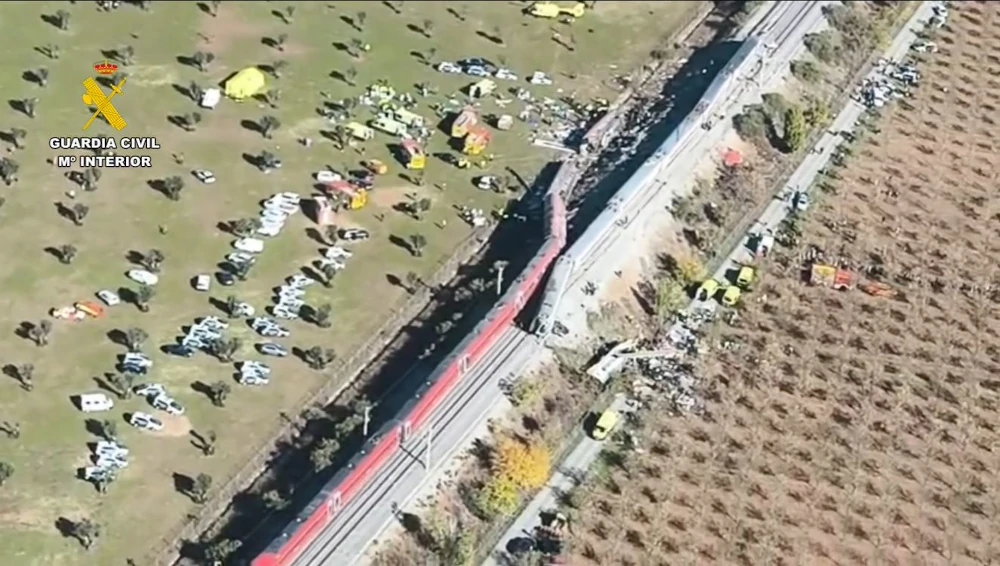
Aerial view of the trains involved in the accident in Urda (Toledo). Screenshot from drone footage recorded by the Guardia Civil.
The collision occurred at around 08:54, between Los Yébenes and Urda, at kilometre 118 of the Madrid-Seville high-speed railway line. According to Adif, the accident occurred when one train struck another from behind while both were travelling on the Madrid-Seville route. The Renfe AVE had departed from Madrid-Puerta de Atocha at 08:00 and was scheduled to arrive at Sevilla-Santa Justa at 10:39.
A total of 544 passengers were travelling on the two trains, 397 on the AVE and 147 on the Iryo service, according to figures released by the regional government.
Video | Aerial footage of the train accident in Toledo captured by the Guardia Civil
https://www.youtube.com/watch?v=Ix8ZGHUyQLw
Óscar Puente questions decision to resume train services
Transport Minister Óscar Puente has described the collision as “a truly inconceivable accident”. He explained that at around 08:30, a computer failure disabled the LZB safety system along a 69-kilometre section of the line, where approximately six trains were travelling.
After the trains had been brought to a halt, Adif’s control centre at Atocha authorised them to resume their journeys. Puente described this decision as “inexplicable”, as the trains should have been travelling at a maximum speed of 40 km/h without the protection of the safety system. The Renfe AVE subsequently collided with the Iryo train, which remained stationary. The circumstances surrounding the accident remain under investigation.
Major emergency response in Toledo
At 10:30, the Government of Castilla-La Mancha raised the Castilla-La Mancha Territorial Emergency Plan (PLATECAM) to operational level 2, after requesting the deployment of the Military Emergency Unit (UME) to reinforce rescue operations and assistance to victims. UME personnel have already been deployed to the accident site.
Officers from the Guardia Civil, firefighters from Toledo, Ciudad Real, Albacete and Madrid, Civil Protection volunteers, medical teams from the Castilla-La Mancha Health Service (SESCAM) and INFOCAM personnel and resources have been deployed to the scene.
Medical teams have set up an Advanced Medical Post to treat those affected, assess the severity of their injuries and organise the transfer of injured passengers to hospitals. According to information reported by Castilla-La Mancha Media, hospitals receiving injured passengers include Hospital Universitario de Toledo, Hospital Mancha Centro in Alcázar de San Juan and hospitals in Ciudad Real and Albacete.
The Red Cross psychosocial support teams and the College of Social Workers have also been alerted.
The regional government has opened the Urda sports hall as temporary accommodation for those affected. Family assistance centres have also been established at Atocha station in Madrid, Santa Justa station in Seville and Córdoba station, as well as at the Santo Cristo de Urda school sports hall.
Meanwhile, Renfe has activated its crisis management team and its Assistance Plan for Victims of Railway Accidents and Their Families (PAVAFF).
High-speed rail services suspended between Madrid and Andalusia
Adif has suspended rail services between Madrid, Ciudad Real and Andalusia following the accident. According to the rail infrastructure manager, trains travelling along this corridor were held at stations along the route.
Adif has established assistance points for those affected at four stations:
- Madrid-Puerta de Atocha Almudena Grandes.
- Sevilla-Santa Justa.
- Córdoba-Julio Anguita.
- Málaga-María Zambrano.




Leave A Comment