
The fascination with origins is a fundamental human drive. To see, or to touch with one’s own hands, a Greek, Babylonian, or Pharaonic Egyptian ring induces a hypnotic sense of vertigo, as if we were traversing time itself. Objects crafted centuries ago by human hands possess an enigmatic allure, as they instantly connect us to remote eras. And among all the artefacts that have surrounded humankind across diverse cultures, one has undoubtedly displayed the greatest temporal endurance -the one that has most effectively withstood the passage of time whilst remaining alive. I am referring to the house. The architect Eugène Viollet-le-Duc stated in his Histoire de l’Habitation Humaine that the house is the cultural element that best symbolises a people’s way of being.
Popular housing types —the mental image people hold of a ‘home’— possess an antiquity far greater than is usually attributed to them: the very idea of the house thus becomes an archaeological fact of the first order. Prior to the 20th century, the vernacular house in every location adhered to specific models —or ‘types’— that endured for centuries with barely any variation, including their exterior appearance. Houses would age to the point of ruin, but they were rebuilt without change time and time again, just as with other objects surrounding humankind: clothing, boats, farming implements, and tools. There existed an idea of the house that was maintained generation after generation. The evolution of object design was remarkably slow from the Neolithic period through to the 19th and 20th centuries. These housing ‘types’ were repeated over and over, just as other objects were, to the point of defining entire geographical regions. It was customary to speak of ‘a Basque house’, ‘a Lombard house’, a Phrygian cap, or a Swiss Army knife. The artisan’s goal was not innovation in design, but rather its perfection. The carpenter, blacksmith, cobbler, or master builder took pride in having introduced some detail capable of improving what they had received from a centuries-old tradition, which had already become something almost perfect. Today, houses are conceived by individual architects, and each one is different. But before the 20th century, they responded in every region to models that people held in mind, and which they repeated ad infinitum.
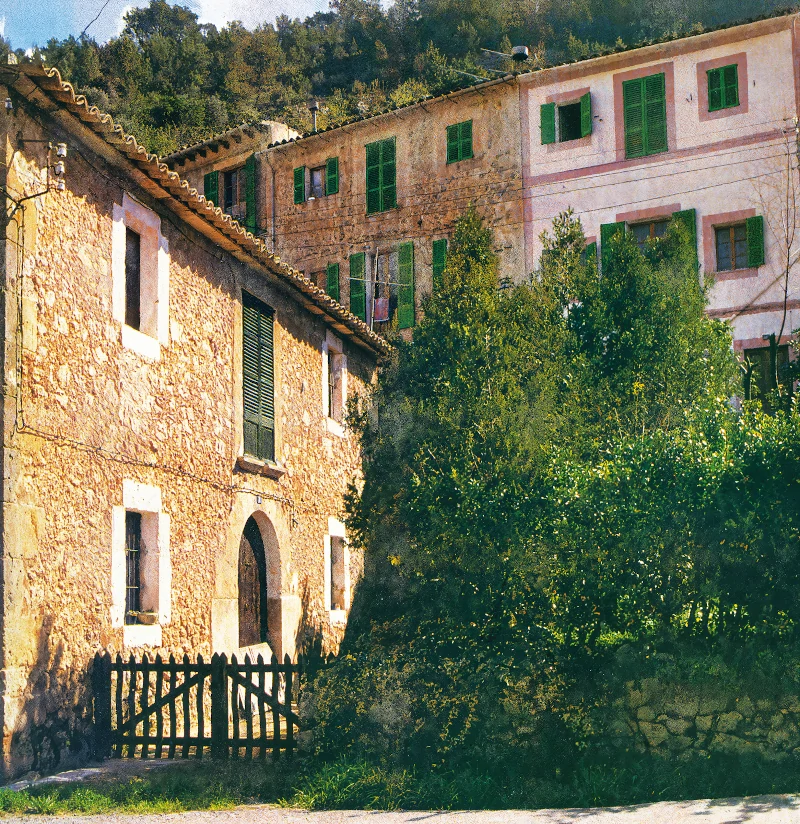
The traditional “house with three holes” is one of the most recognisable and enduring models of Mallorcan vernacular architecture.
These objects were faithful emissaries of past generations, and the idea of the house was no exception to this slow evolution. The Industrial Revolution facilitated the mobility of ideas and people, and in architecture, it gave rise to styles of an international character, by then detached from the history and traditions of each location.
In Mallorca, one can speak of a single, consolidated type of vernacular house, which offers an elemental yet striking image. It is the ‘three-aperture house’: a wide, symmetrical facade of about 15 metres, with a central entrance and two lateral rooms. The most basic version consists of a ground floor and a single structural bay, but it can be extended horizontally (a double bay) or vertically (two storeys). It is found isolated in the countryside, as well as in towns and cities. The majority of the houses seen in the rural areas of Mallorca correspond to this type and its variations.
And the question I put to you is: when and why did this type of house appear in Mallorca? What is its historical origin? Who were the first to build it? Why did it take root so decisively? This is the enigma I wish to pose today. Following painstaking research, we provided the answer in the book Arquitectura Tradicional de la isla de Mallorca. In the next article, I shall tell you how we managed to resolve the mystery, to explain the origin of this house and the historical moment in which it was established, many centuries ago now. We were even able to determine the exact year.






Leave A Comment