
The Museu de Mallorca will take part this year in an exhibition at the Museo Nacional del Prado with two outstanding medieval works in the Italo-Gothic style: The Crucifixion Panel and the Altarpiece of Saint Quiteria. Both works have already been packed and are being transferred to Madrid, where they will form part of the exhibition A la manera de Italia. España y el gótico mediterráneo (1320-1420), which will open on 25 May and can be visited from 26 May to 20 September.
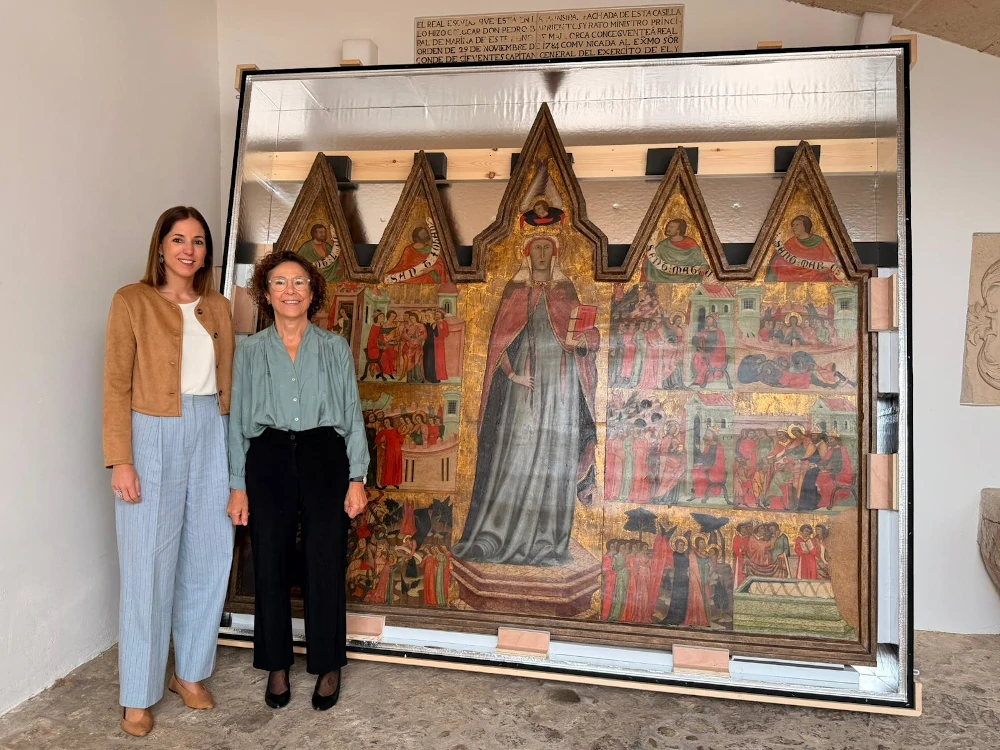
The vice-president of the Consell de Mallorca and councillor for Culture and Heritage, Antònia Roca (left), beside the “Altarpiece of Saint Quiteria”. Photo: Consell de Mallorca.
The Prado exhibition will bring together more than one hundred works from 31 Spanish institutions and 25 international institutions to analyse the influence of Italian Trecento art on the peninsular territories between the 14th and 15th centuries.
Restoration open to the public
The Consell de Mallorca has recently completed the restoration of the two works. The project took place inside the museum’s own galleries and was open to the public. The intervention, carried out by restorers Estrella Armendáriz and Caterina Fiol, included consolidation, surface cleaning and stabilisation work before the pieces were transferred.
The vice-president of the Consell de Mallorca and councillor for Culture and Heritage, Antònia Roca, said that taking part in this exhibition “represents a step forward in the external promotion of Mallorca’s artistic heritage and places the museum in a first-rate context”. She also highlighted the educational value of a restoration process that allowed visitors to observe a usually little-seen task at close quarters.
Two landmarks of Mallorcan Gothic art
The Crucifixion Panel, produced between 1343 and 1358, is one of the most outstanding works of Mallorcan Gothic art. From the royal chapel of Santa Ana in La Almudaina, it was commissioned by Peter the Ceremonious from the painter Ferrer Bassa and later continued by Ramon Destorrens. Painted in tempera on a gold-leaf panel, the work shows a central scene of the crucifixion with stylised figures and a colour palette typical of the Italo-Gothic style.
For its part, the Altarpiece of Saint Quiteria, attributed to Joan Loert and dated to around 1346, comes from the former Hospital de Sant Antoni in Palma. The piece depicts different scenes from the life and martyrdom of Saint Quiteria, regarded as a protector against the so-called “holy fire” or Saint Anthony’s fire, through a visual narrative characteristic of Mediterranean Gothic art.







Leave A Comment