
Balears now has its first satellite in space. Posidònia has successfully completed its launch and opens a new chapter for the technological innovation of the archipelago. The project, developed by Open Cosmos and co-funded by the Govern with European funds, will provide strategic data to improve public management and strengthen the islands’ position in the European aerospace sector.
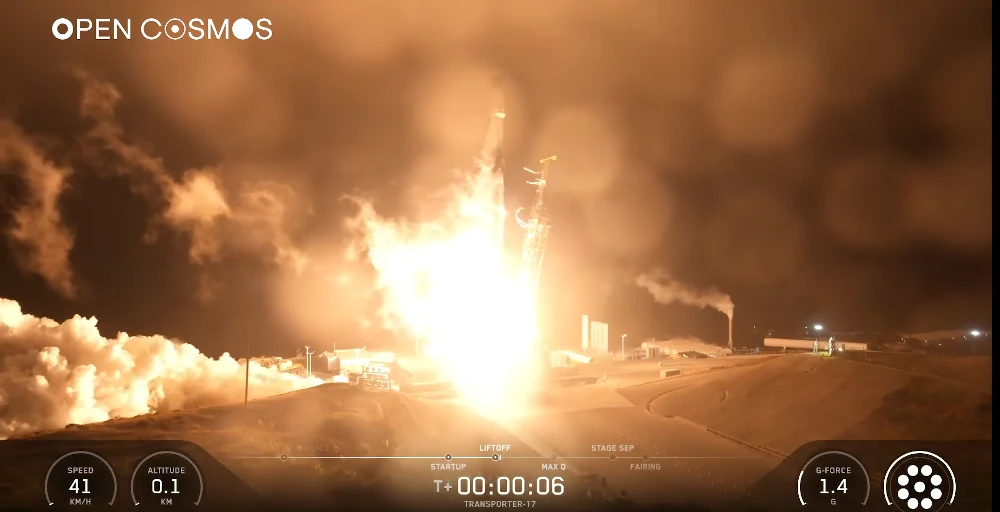
Image of the launch of the rocket that carried Posidònia into space. Photo: CAIB / Open Cosmos.
The launch took place at 9:10 am (Spanish mainland time) on 7 July from Vandenberg Space Force Base, in California (United States), aboard a SpaceX rocket, the aerospace company founded and led by Elon Musk. Posidònia travelled alongside the Hyperion GR-1 satellite as part of the initial deployment of OpenConstellation 1.0. This new Earth observation constellation aims to provide near-real-time information to improve the response to emergencies, climate change monitoring and land management. In addition, Posidònia will support infrastructure planning, the analysis of tourist flows and data-driven decision-making. The aim is to move towards more efficient, sustainable management supported by accurate information.
Three million euros of investment
The Govern has allocated three million euros to this initiative, which forms part of its strategy to promote innovation, encourage public-private collaboration and diversify Balears’ economic model. The Executive believes that Posidònia shows the archipelago’s ability to lead high-value-added technology projects with international reach.
The first vice-president and minister for Economy, Finance and Innovation, Antoni Costa, highlighted the scope of the project after the launch.
“Posidònia represents much more than a technological advance. It proves that the Balearic Islands can lead high-value-added projects linked to the new economy, generating knowledge and promoting technology-intensive sectors.”
The Balears satellite will improve land management
Posidònia forms part of a new generation of satellites designed to drastically reduce the time needed to receive information from space. Until now, this data could take between two days and several days to become available. The new Open Cosmos constellation aims to deliver it in just 30 minutes. This capacity will make it possible to react more quickly to fires, floods, extreme weather events and other emergency situations.
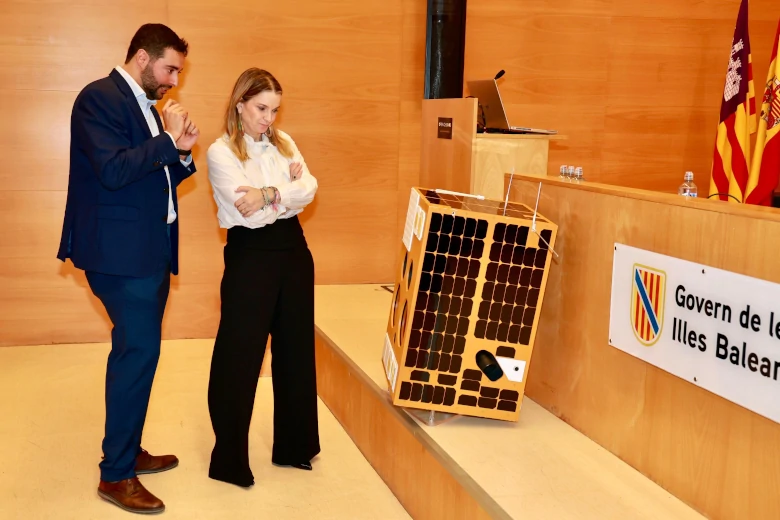
Rafel Jordà, CEO and founder of Open Cosmos, and Marga Prohens, president of the Govern, in front of a replica of the Posidònia satellite. Photo: CAIB.
To achieve this, the Balears satellite combines multispectral and hyperspectral sensors capable of obtaining high-resolution images and detecting changes in the territory with great precision. It also includes on-board artificial intelligence systems and technologies that process part of the information before it even reaches Earth.
Open Cosmos plans to complete the deployment of this constellation with new launches throughout this year. Once fully operational, it will be able to capture information on up to three million square kilometres per day, with several revisits to the same point. This will provide much more up-to-date data to support decision-making, according to Open Cosmos on its website.
A strategic project to turn Balears into an innovation hub
The project was presented in January 2025. One month later, the president of the Govern, Marga Prohens, and the CEO and founder of Open Cosmos, Rafel Jordà, took part in the symbolic start of the countdown to the launch. More information is available at this link.
In May this year, Antoni Costa visited Open Cosmos’ facilities at ParcBit to check the final condition of the satellite before it was transferred to the launch centre. More information is available at this link.
With Posidònia now in orbit, Balears takes another step towards becoming a benchmark for innovation in the Mediterranean, as Jordà had already suggested in an interview published in the winter 2023-24 edition of Mallorca Global Mag (more information is available at this link). The project also strengthens ParcBit’s role as an attractive environment for technology companies and consolidates collaboration between administrations, companies and knowledge centres to promote initiatives with international impact.






Leave A Comment