
 Mallorca now has a sufficient critical mass of population to attract initiatives that, not so long ago, would have seemed unthinkable. The strong demographic momentum of recent years, driven above all by people arriving from Latin America, Africa and northern European countries, together with new investment in tourism and education, has generated far more wealth than already existed and, with it, has led to the emergence, among other things, of new educational, cultural, leisure and health options.
Culture and health. Mens sana in corpore sano, in its modern sense. Since it is already well known, I will not dwell here on the other side of the coin: overcrowding, social touristification and their obvious, unstoppable consequences.
Particularly noteworthy is the overcoming of the anaemia in university education that we have endured for far too long, due to limited options and to the deep-rooted tradition of school dropout in our islands. This, as is well known, is common in societies where economic prosperity derives not so much from human effort as from the qualities of a natural environment that is, in itself, immensely beautiful and attractive.
According to the sources consulted, 44% of young people who have passed the university entrance exams leave the islands because they cannot find the higher education offer they were looking for; because, thinking ahead, the island labour market holds little appeal owing to its low level of qualification; or also because they wish to experience, in other places, that attractive university period which is often remembered as one of the best stages in a person’s life.
Now, however, the range of private university options, usually more expensive than public education, is expanding. Alongside the already established Felipe Moreno University School, affiliated with Madrid’s Antonio de Nebrija University; CESAG, affiliated with the Pontifical University Comillas; and the recently created University of Mallorca-Adema (UMAC), comes the powerful CEU San Pablo.
Will this prove excessive, or does it fall within the bounds of what is reasonable and necessary? The market will tell. For now, we welcome these initiatives in the hope that they will significantly improve competition in higher education on the islands, retain local talent and attract talent from elsewhere, reduce educational dropout and, at the same time, enhance the prospects of diversifying the labour market into new business sectors beyond tourism.
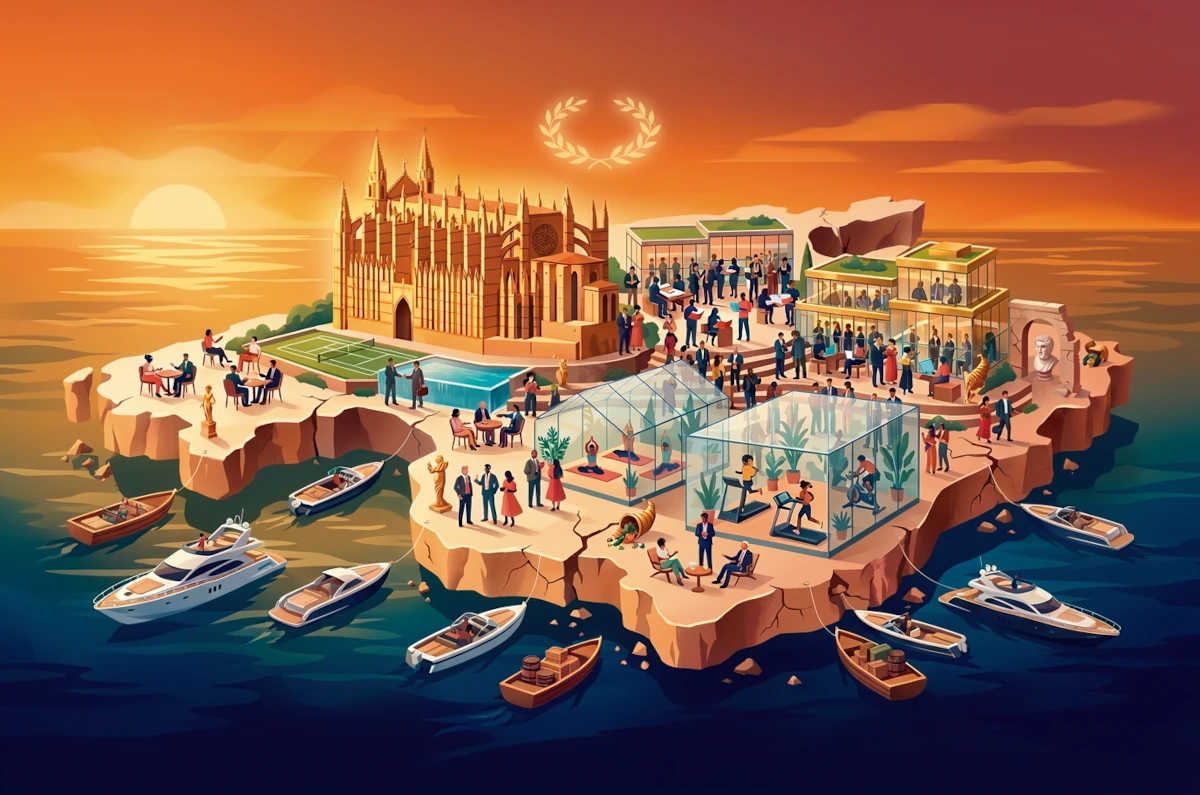
Another manifestation of the standard of living we enjoy in these islands, as reflected in the Forefront report we publish in this edition, concerns health, personal care and aesthetics: the Balearic Islands lead Spain’s fitness boom. They have the highest business density in the country, top the ranking for household spending and are at the forefront of regular sports practice. No small matter.
This level of wellbeing is also reflected in the high percentage of the population registered with gyms, associations or sports clubs, whether public or private. What used to be decisions made almost the day before —going to the gym, attending a class, practising individually or training outdoors in any sporting discipline— are now marked as unavoidable appointments in the daily schedules of a large share of the population. Sport long ago ceased to be the commitment sacrificed in personal diaries.
Gyms and sports clubs, those sacred spaces of hedonism and narcissism if ever there were any, have become established as centres for socialising, creating environments and groups of friends among people who share sporting, leisure and wellbeing interests.
As we explain in the report, a rich and ambitious industry with considerable growth potential revolves around the gym: natural performance foods and designer supplements designed to support nutrition. This segment, together with nutricosmetics and anti-ageing supplements, has evolved so significantly over the past 20 years that we can now speak of annual turnover of around €3 billion nationwide, of which the Balearic Islands undoubtedly take a sizeable share.
As a counterpoint, I bring up the report we include in this issue on our extremely limited food sovereignty. In ancient Rome, when a general entered the Eternal City on his triumphal chariot after a victory, acclaimed by the people, he had a servant beside him who, while holding the laurel wreath above his head, would say to him: “Memento mori”, “Remember that you are mortal”, in order to temper his divine pretensions.
In our case, we must remember: “Memento te insulam fragilem esse”. Remember that you are only a fragile island.






Leave A Comment