
After decades studying Ciutat, Bartomeu Bestard presents his new book, Historia de la ciudad de Palma, a journey that turns dates into narrative, connecting key moments from prehistory to the present day through an approach that combines historical rigour with a strong gift for storytelling.
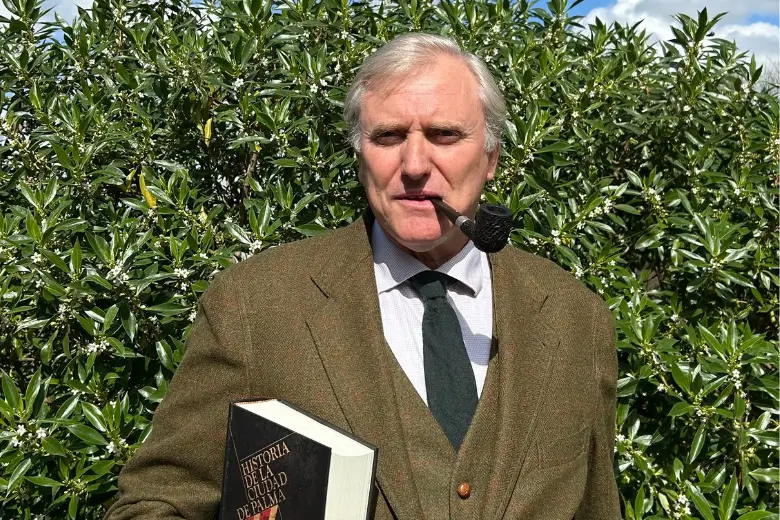
– The book brings together a series of chronicles spanning from prehistory to the present day. What is the common thread that connects them?
– The common thread is the city itself and the historical perspective I have developed on Palma after nearly thirty years devoted to studying it, understanding history as a constant succession of events. Simply compiling articles in chronological order would have been a mistake. History needs to be told as a narrative, because that is what makes it accessible to the reader. My aim has been to tell the story of Palma in a clear and engaging way.
– After 20 years as Ciutat’s official chronicler, what fresh perspective do you bring to Palma’s history?
– Since 1997, when I first came into contact with the Societat Arqueològica Lul·liana, I have focused my reading and research on the city of Palma. I have also closely followed Mayurqa, the journal published by the Department of History and Theory of the Arts at the University of the Balearic Islands (UIB), along with other specialised publications featuring studies on different aspects of Palma’s history. As a result, I believe I have developed a broad understanding of my city’s history, enriched by the historiographical contributions of the last forty years.
– The book’s synopsis promises an engaging and accurate historical account aimed at all kinds of readers. How do you make a subject that can seem dense and difficult to approach more accessible?
– In 2005, José Iglesias, who was then the director of Diario de Mallorca, invited me to write a series of articles on the history of Palma. That experience forced me to condense episodes that would normally require lengthy explanations into just two pages, while still making them engaging and accessible for all kinds of readers. To this, I should add the influence of reading books by great writers which have been an essential school for me.
– Taking into account all the different elements explored throughout the chronicles, what would you say was the finest period in Palma’s history? And the darkest?
– I believe the Black Death of 1348 and the great flood of 1403 were two truly apocalyptic episodes in Palma’s history. Identifying its finest period is more difficult. Perhaps the years between 1270 and 1343 represent one of the city’s golden ages. By then, the Kingdom of Mallorca was already firmly established after the conquest, and Palma experienced intense commercial activity, further driven by major urban investments.
– How has your role as Ciutat’s official chronicler influenced the writing of the book? Has it helped shape your approach?
– It has certainly helped me when writing the book. I have spent many years dealing with all kinds of questions about our history, reading articles and essays, and discussing and debating research with fellow historians.
– What is it like to turn historical events into literature?
– More than creating literature itself, literary influence, as well as engaging with writers and sharing their perspectives, has been essential in the way I narrate the history of Palma. Without literature, history would not be intelligible.





Leave A Comment