
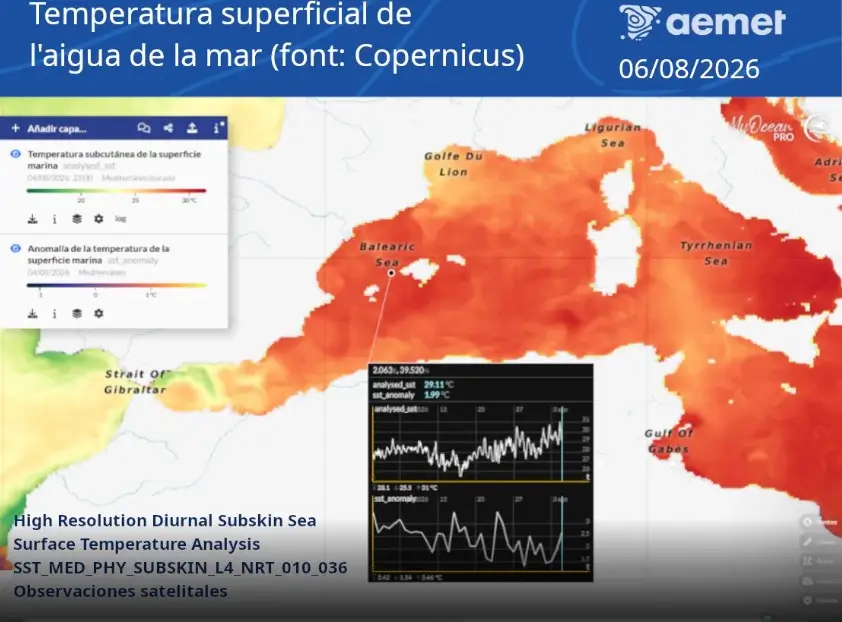
The sa Dragonera buoy recorded a sea surface temperature of 33.02°C on 5th August, the highest value measured at this location to date. Satellite data also show anomalies of close to two degrees around the Balearic Islands.
The sea temperature in Mallorca has reached a new all-time high. The sa Dragonera buoy, which forms part of the Puertos del Estado monitoring network, recorded a sea surface temperature of 33.02°C on Wednesday, 5th August.
AEMET Baleares reported that this was the highest sea surface temperature ever measured by the buoy. Analyses based on satellite data also indicate anomalies of around two degrees above the usual values in the waters surrounding the archipelago, according to Copernicus Marine.
New sea temperature record in Mallorca
The reading of 33.02°C is significantly higher than the previous maximum values recorded by the sa Dragonera buoy. In August 2024, it reached 31.87°C, surpassing the previous record of 31.36°C measured in 2022. The new reading raises the all-time maximum by more than one degree compared with the 2024 record.
The measurement is particularly significant because it was recorded in early August. Mediterranean sea temperatures usually reach their highest levels later in the summer, after weeks of accumulated solar radiation and atmospheric heat.
What does the sa Dragonera buoy measure?
The buoy forms part of the Puertos del Estado Offshore Buoy Network, which consists of monitoring stations located in deep waters away from the coast. These devices collect real-time information on sea temperature, waves, currents and other oceanographic variables.
The 33.02°C reading therefore corresponds to a specific measurement at the buoy’s location and does not mean that all beaches and coastal areas of Mallorca are experiencing exactly the same temperature.
Depth, currents, wind, coastal orientation and the time of day can produce significant differences between areas. However, satellite data confirm that the warming is not limited to sa Dragonera and that much of the water surrounding the Balearic Islands is considerably warmer than usual.
An exceptionally warm Mediterranean since spring
The record follows several months of abnormally high sea temperatures. The sa Dragonera buoy had already reached 26.2°C on 30th May, the highest value in its series for that month. Puertos del Estado reported at the time that record temperatures had been measured at many of its buoys in the Mediterranean, the Cantabrian Sea and Galicia.
At the end of June, data from the European Copernicus programme also showed above-average sea surface temperatures across large areas of European waters. The most intense anomalies approached six degrees in some parts of the western Mediterranean.
The pattern observed throughout the spring and summer therefore points to sustained warming rather than an isolated peak lasting only a few hours.
What consequences can such a warm sea have?
Exceptionally high sea temperatures can affect both marine ecosystems and environmental conditions in coastal areas. Copernicus identifies the Mediterranean as one of the regions particularly affected by marine heatwaves, which can alter habitats and cause thermal stress in numerous species.
A warmer sea also releases more moisture and becomes less effective at cooling coastal areas. This can increase the feeling of mugginess and make it more difficult for temperatures to fall during summer nights, particularly when stable atmospheric conditions, light winds and high humidity occur at the same time.
However, high sea temperatures alone do not cause torrential rainfall. Warm water can supply energy and moisture to the atmosphere, but intense storms also require other meteorological factors, including cold air at higher altitudes, atmospheric instability and favourable circulation patterns.
Monitoring sea temperatures in the Balearic Islands
The situation will continue to be monitored through Puertos del Estado buoys, AEMET analyses and Copernicus Marine satellite monitoring products.
A single record temperature is not enough for conditions to be formally classified as a marine heatwave. Temperatures must remain above the 90th percentile of historical values for that location and time of year for at least five consecutive days.
The sa Dragonera record is, in any case, another indicator of the exceptional warming affecting Mallorca’s waters during the summer of 2026.






Leave A Comment