The Balearic Islands’ Coastal Cleaning Service has removed 34.2 tonnes of waste from the archipelago’s waters and coastline during the 2026 campaign, which ran from May to September. Mallorca accounts for more than half of the waste collected, with 17.5 tonnes, while plastic and wood make up the majority of the materials recovered.
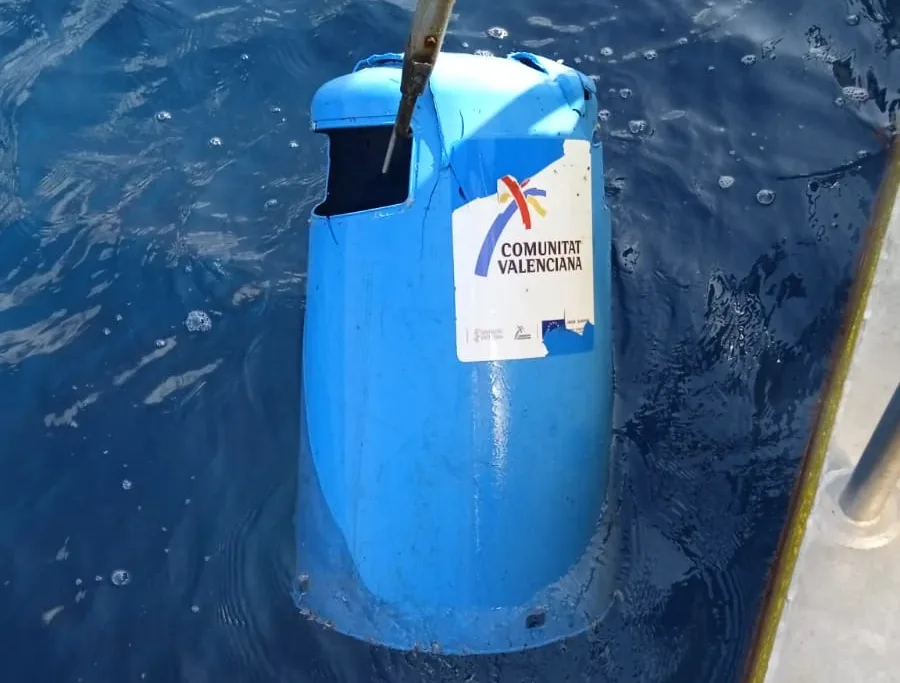
Removal of a plastic container from Balearic coastal waters during the 2026 cleaning campaign. Photo: CAIB.
The operation, coordinated by the public company PortsIB, which operates under the Conselleria de la Mar i del Cicle de l’Aigua, involved 23 vessels, of which 15 were assigned to beach areas and eight to coastal waters. Their work focused on removing floating waste and hazardous objects to protect bathing areas and improve navigation safety.
Mallorca accounts for the largest amount of waste collected along the Balearic coast
Of the 34,192 kilograms removed across the Balearic Islands, Mallorca recorded the highest amount, with 17,553 kilograms, followed by Eivissa, with 7,943; Menorca, with 6,684; and Formentera, with 2,012.
In Mallorca, the municipalities where the largest amounts of waste were collected were:
- Felanitx: 2,851 kilograms.
- Pollença: 2,332 kilograms.
- Santanyí: 2,198 kilograms.
- Andratx: 2,170 kilograms.
- Manacor: 1,311 kilograms.
- Alcúdia: 1,092 kilograms.
Elsewhere in the archipelago, Sant Josep de sa Talaia in Eivissa recorded 5,098 kilograms, while Ciutadella in Menorca accounted for 1,780 kilograms.
Plastic and wood are the most commonly collected types of marine waste
Plastic was the most abundant material, with 15,851 kilograms removed, followed by wood, with 12,546 kilograms. Together, they accounted for approximately 83% of all waste recovered during the season.
The service also collected 3,118 kilograms of other materials, 1,918 kilograms of vegetation, 704 kilograms of organic matter and 54 kilograms of oils and hydrocarbons.
During the five-month campaign, the service responded to 39 reports, of which 25 came from the 112 emergency service and Salvamento Marítimo. Operations included removing logs, buoys and boat debris, as well as responding to incidents involving sunken vessels and fuel spills.
Among the more unusual incidents were the removal of a 40-metre-long pipe in Menorca and the rescue of a live goat from the waters off Mallorca.
In addition to its cleaning operations, the service worked with scientific organisations including the CSIC, SOCIB and the Instituto Oceanográfico to collect data and monitor jellyfish and microplastics in Balearic waters.


Leave A Comment