
The proportion of boats anchoring on Posidonia seagrass meadows in the Balearic Islands fell to 4% in 2026, the lowest percentage since the Servei de Vigilància de la Posidònia (Posidonia Monitoring Service) began operating in 2018, when the figure stood at 17.3%. During the latest season, which ran from 15 May to 10 October, a total of 137,685 anchoring operations were checked, of which 5,510 involved an anchor or chain resting on Posidonia seagrass.
In these cases, staff from the service, managed by the Institut Balear de la Natura (IBANAT), asked boat operators to move their anchorage to sandy seabeds to prevent damage to the meadows. The proportion of improper anchoring operations also represents an improvement on 2025, when it stood at 6.4%.
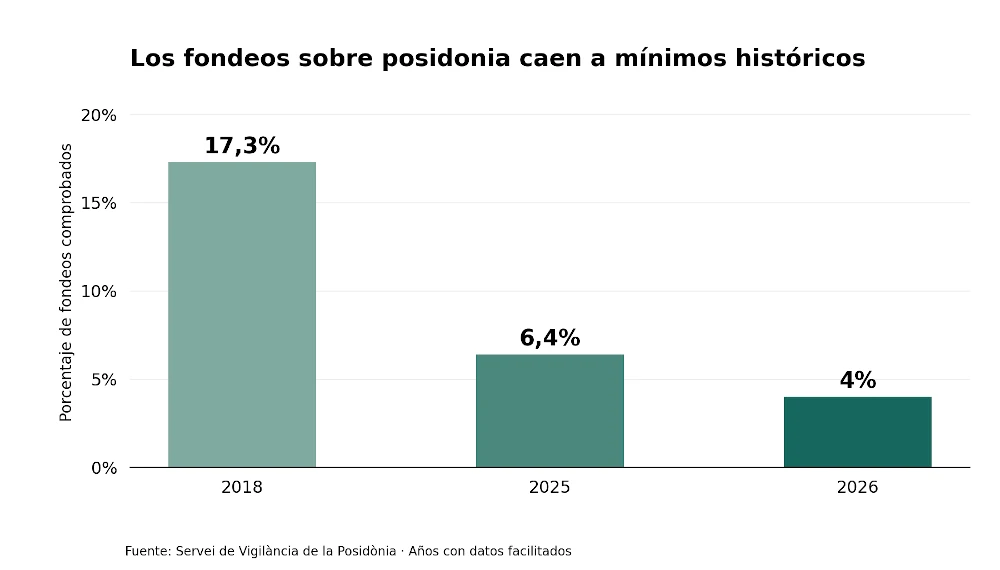
The proportion of improper anchoring operations has fallen by 13.3 percentage points since 2018. The reduction refers to inspected boats, not to the area of Posidonia seagrass damaged.
In total, the service carried out 154,335 operations during the season, including anchoring inspections, providing information to boat operators and offering guidance on anchoring manoeuvres. The Govern points out that protecting Posidonia requires more than simply placing the anchor on sand, as the chain can also come into contact with the seagrass meadows and damage them.
Formentera records the lowest proportion of boats anchoring on Posidonia
The results from the Posidonia Monitoring Service reveal significant differences between the islands. Formentera recorded the lowest percentage, at 1.5%, while Eivissa saw the largest reduction compared with 2025, falling from 21.3% to 10%.
The breakdown of anchoring operations inspected during the 2026 season is as follows:
| Island | Inspected | On Posidonia | % |
|---|---|---|---|
| Mallorca | 41,378 | 2,163 | 5.2% |
| Menorca | 24,807 | 954 | 3.8% |
| Eivissa | 15,093 | 1,526 | 10% |
| Formentera | 56,407 | 867 | 1.5% |
| Total Balearic Islands | 137,685 | 5,510 | 4% |
Mallorca has also seen a notable long-term improvement, with improper anchoring falling from 32.2% in 2018 to the current 5.2%. However, Portocolom, Palma and Andratx remain among the areas with the highest incidence, with percentages close to 6%.
In Eivissa, Talamanca, Sant Antoni Bay and Cala Jondal are among the locations requiring particular monitoring because of intense boating activity. In Formentera, where more than 56,000 inspections were carried out, almost half of improper anchoring cases involved chains coming into contact with seagrass meadows, even though the anchors themselves were positioned on sand.
During the campaign, officials also issued 76 official reports as part of monitoring and enforcement activities: 52 in Mallorca, 18 in Eivissa, five in Formentera and one in Menorca. The figure could still rise, as further reports are being processed.
Posidonia 2030 to receive almost €5 million to protect seagrass meadows
The end of the 2026 season also marks the conclusion of the current contract for the Posidonia Monitoring Service. To ensure its continuation, the Govern has prepared Posidonia 2030, a project with a budget of €4.98 million funded through the Sustainable Tourism Tax (ITS).
The initiative will initially run for two years, with the possibility of extending it for a third, and will bring together anchoring surveillance, scientific monitoring, data management and environmental education.
Planned measures include strengthening the Posidonia Monitoring Network, which currently has 46 monitoring stations, and establishing a Posidonia Observatory to bring together information on the condition of seagrass meadows, anchoring activity and other impacts on the seabed.
The project also provides for closer coordination between monitoring bodies and new awareness campaigns aimed at the boating sector and the general public, with the aim of preventing damage to one of the Mediterranean’s most important habitats.



Leave A Comment