
The large demonstration held in Palma on 11 November contrasted with the uneven participation in the general strike across workplaces in the Balearic Islands. The trade unions organising the protest estimated that 45,000 people took part in the afternoon march, compared with the 10,000 estimated by the National Police. As for participation in the strike, while the unions highlighted support in sectors such as transport, the Govern (Balearic Islands Government) and employers’ associations reported much lower participation figures. Access to housing, higher wages and the protection of public services were the main demands of the day.
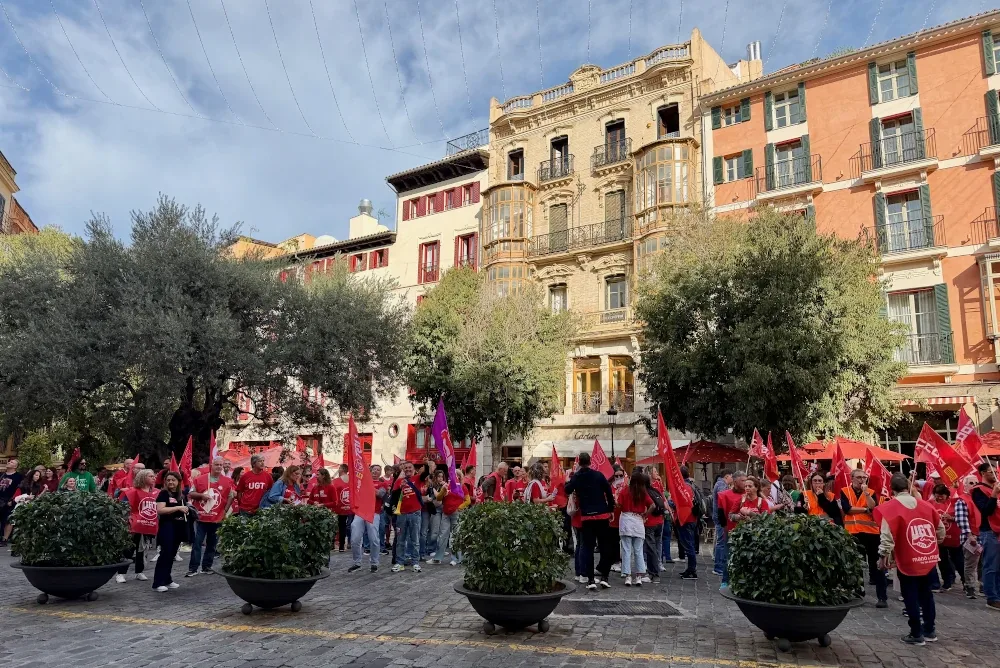
Participants in the demonstration organised by trade unions in Palma during the 11 November general strike. Photo: UGT.
Thousands take to the streets of Palma over housing and wages
The main demonstration of the general strike began at 18:30 in Palma’s plaça d’Espanya and continued along the Avingudes, La Rambla and through the city centre to passeig del Born. Thousands of people joined the march, with access to housing emerging as one of its central demands.
Estimates of attendance varied considerably:
- 45,000 demonstrators, according to the trade unions organising the protest.
- Approximately 10,000 demonstrators, according to the National Police.
The Delegación del Gobierno (Spanish Government Delegation) recorded approximately 20,000 participants across all the demonstrations held in the Balearic Islands, which passed without serious incidents.
The afternoon protest was preceded by a demonstration by education sector workers, who marched through central Palma at midday. Demonstrations also took place elsewhere in the archipelago, including Maó, Ciutadella and Eivissa.
The demands focused on rising housing costs, particularly rents, and the difficulties workers face in meeting living expenses on their wages. The organisers also called for improved working conditions and greater investment in public services.
Trade unions highlight support in public transport
Participation in the general strike varied considerably between sectors and according to the sources consulted. UGT (General Union of Workers) and CCOO (Workers’ Commissions) estimated overall participation at around 48%, although they acknowledged significant differences between industries.
Pedro Homar, UGT’s general secretary in the Balearic Islands, described the start of the day as “lukewarm” and said there appeared to be “more moral than actual support” for the demands.
According to figures released by UGT, participation was as follows:
- Serveis Ferroviaris de Mallorca (SFM, Mallorca Railway Services): 100%.
- TIB interurban transport: 100%.
- Palma’s EMT municipal bus service: 80%.
- Airport: 60%.
- Education: 50%.
- Correos (Spanish postal service): 60%.
- Regional government administration: 30%.
- Spanish central government administration: 30%.
The highest participation rates reported by the union were in public transport, while participation was lower in public administration.
Govern reports 11.7% participation among public employees
The figures provided by the Govern were considerably lower than those reported by the trade unions. According to the regional government, 11.7% of public employees entitled to strike took part, a percentage that excludes staff assigned to minimum essential services.
Participation stood at 14.9% in education and 5.8% in healthcare. In the regional administration’s general services, it reached 8.85%.
The official breakdown by sector was as follows:
- Education: 14.9%.
- Healthcare: 5.8%.
- Regional administration general services: 8.85%.
- Serveis Ferroviaris de Mallorca (SFM): 7.5%.
- TIB interurban buses: 26%.
In education, the highest participation was recorded in Formentera, at 33.9%, followed by Eivissa (16.09%), Mallorca (14.6%) and Menorca (13.35%).
In healthcare, participation was 5.56% in Mallorca, 6.55% in Menorca and 7.45% in Eivissa and Formentera.
The differences between official and union figures were particularly pronounced in public transport. While UGT reported 100% participation at SFM and TIB, the Govern put the figures at 7.5% and 26%, respectively. These figures were provided by different sources, whose counting methods have not been explained on a consistent basis.
The regional government stated that the day passed without incidents and that no problems were reported on trains or at railway facilities.
CAEB and PIMEM report business as usual
Employers’ organisations presented a very different assessment from that of the trade unions. The Confederación de Asociaciones Empresariales de Balears (CAEB, Balearic Islands Confederation of Business Associations) put strike participation at 0.7% as of 15:00, based on information collected from companies in different sectors.
The assessment covered construction, transport, retail, hospitality and tourism, industry, metalworking, healthcare and social services, as well as technology and telecommunications.
The employers’ association said the main disruptions involved transport, mobility and difficulties accessing workplaces, affecting some employees and school transport routes.
Its president, Carmen Planas, described the strike as “incomprehensible to employers” and questioned its status as an industrial dispute. She also defended the right to work of those who chose to continue their normal activities.
Meanwhile, the Federació de la Petita i Mitjana Empresa de Mallorca (PIMEM, Mallorca Federation of Small and Medium-Sized Enterprises) reported that the strike had no impact on microbusinesses, small and medium-sized enterprises or self-employed workers in Mallorca.
Its president, Jordi Mora, said that the vast majority of member businesses had operated normally. Although he acknowledged that the housing shortage also affects the business community, he argued that a strike was not the appropriate way to address a structural problem.
Housing dominates the demands of the 11 November strike
Access to affordable housing was the main reason behind the strike, which also called for higher wages, more dignified working conditions and increased investment in public services.
The trade unions argued that high rents are making it increasingly difficult for workers to live in the islands, even when they have stable employment. The loss of purchasing power and the widening gap between wages and the cost of living were also central arguments behind the protest.
The day therefore produced two very different assessments: a large demonstration reflecting public discontent over housing and living conditions in the Balearic Islands, and highly uneven participation in the strike itself, with particularly wide discrepancies between the figures reported by trade unions, the Govern and employers’ associations.





Leave A Comment