
The water reserves in the Balearic Islands fell to 36% in September 2026, two percentage points lower than in August and eight points below the level recorded a year ago. Several areas of Mallorca remain under drought alert, particularly Artà, es Pla and Manacor-Felanitx, while September rainfall was below normal levels.
Water reserves in Mallorca fall to 36%
According to the latest figures from the Conselleria de la Mar i del Cicle de l’Aigua, Mallorca’s water reserves also stand at 36%, Eivissa has fallen to 33% and Menorca has improved to 38%. Most of the archipelago remains under drought alert or pre-alert.
- Mallorca: 36%, compared with 38% in August.
- Menorca: 38%, compared with 33% the previous month.
- Eivissa: 33%, compared with 37% in August.
The situation is worse than a year ago. In September 2025, water reserves in the Balearic Islands stood at 44%, eight percentage points higher than at present.
Menorca’s recovery is particularly striking because it has occurred despite very little rainfall. During September, just 3.4 litres per square metre were recorded, compared with the usual 60.
The Conselleria explains that aquifer levels do not depend solely on rainfall during the same month. Water takes time to infiltrate the ground and reach underground layers, meaning that rainfall from previous weeks or months may only be reflected in aquifer levels later.
The amount of water extracted also plays a role. A reduction in extraction can help reserves recover, even during dry periods.
Drought in Mallorca: which areas remain under alert?
The Balearic Islands’ hydrological drought index remained stable during September, with an overall value of 0.342, identical to August and slightly higher than a year ago (0.337).
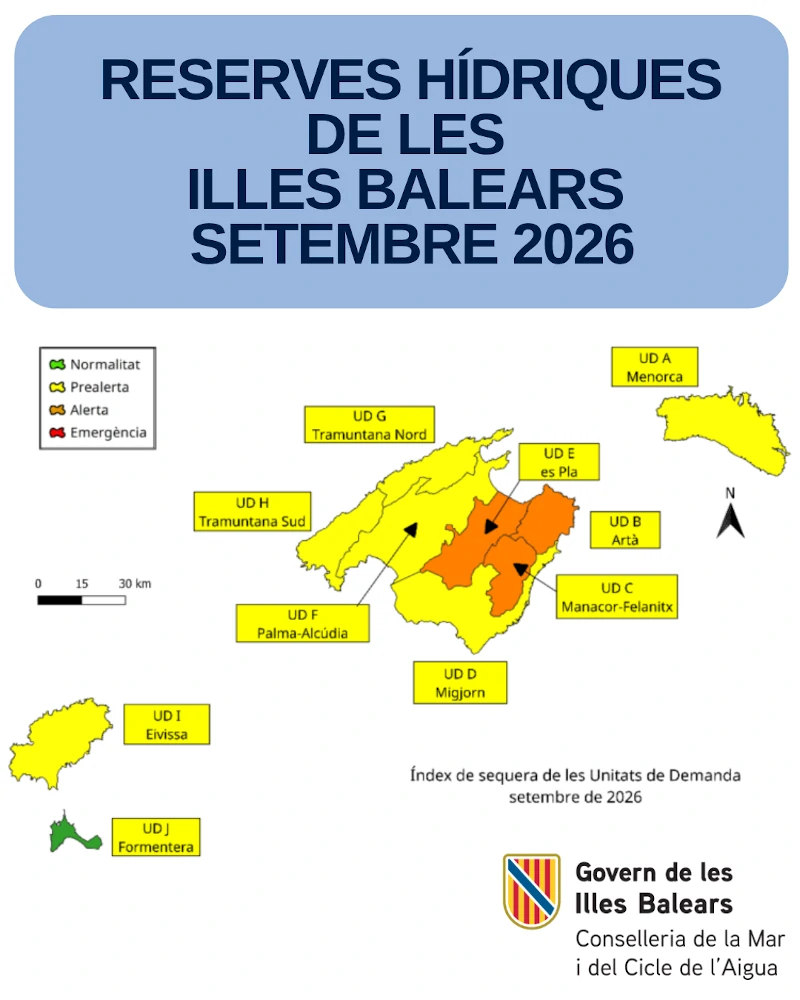
According to the Balearic Government’s drought map, the water demand units are distributed as follows:
- Alert: Artà, es Pla and Manacor-Felanitx, representing 22.5% of the territory.
- Pre-alert: Menorca, Migjorn, Palma-Alcúdia, Tramuntana Nord, Tramuntana Sud and Eivissa, covering 75.9%.
- Normal conditions: Formentera, accounting for the remaining 1.6%.
Therefore, 98.4% of the Balearic Islands’ territory is under drought alert or pre-alert, according to the percentages published by the Conselleria.
During September, four water demand units recorded a deterioration in their index, another four improved and two remained virtually unchanged.
The most significant recovery was recorded in Migjorn, where the index rose from 0.286 to 0.344. By contrast, the largest declines occurred in Artà and Manacor-Felanitx.
September rainfall 30% below normal in the Balearic Islands
Figures from the Spanish State Meteorological Agency (AEMET) confirm that September was a dry month in the Balearic Islands. Average rainfall reached 47 litres per square metre, compared with the usual 68, representing a deficit of 30%.
There were considerable differences between the islands:
| Island | September rainfall | Usual average |
|---|---|---|
| Mallorca | 55 l/m² | 65 l/m² |
| Menorca | 3.4 l/m² | 60 l/m² |
| Eivissa | 10 l/m² | 76 l/m² |
| Formentera | 10 l/m² | 44 l/m² |
Menorca and Eivissa recorded the most severe rainfall deficits. Rainfall in Mallorca was also below normal levels, although the difference was smaller.
As for accumulated rainfall over the past twelve months, the Balearic Islands as a whole stand at 94% of the historical average.
Will water reserves recover in October?
The Conselleria de la Mar i del Cicle de l’Aigua expects a slight increase in water reserves during October, taking into account the current hydrological situation and the time of year.
The Balearic Government continues to monitor available water resources, particularly in areas that remain under drought alert, and stresses the need to use water responsibly.



Leave A Comment