
In the early hours of Friday 28 August, a partial lunar eclipse in Mallorca and the rest of the Balearic Islands will be visible. The phenomenon can be observed with the naked eye, with no need for eye protection or special equipment.
In Palma, the partial phase will begin at 04:34 and reach its maximum at 06:12:53, according to data from Spain’s National Geographic Institute (IGN). At that point, the eclipse will have a magnitude of 0.92 and the Moon will be 11.2 degrees above the horizon. The Moon will set at 07:21 while still eclipsed. The partial phase will end at 07:52, when it will no longer be visible from Mallorca.
Times of the partial lunar eclipse in Mallorca
The Moon will become progressively more obscured from 04:34 until the eclipse reaches its maximum shortly after six in the morning. From then on, the Earth’s shadow will begin to move away from the lunar disc.
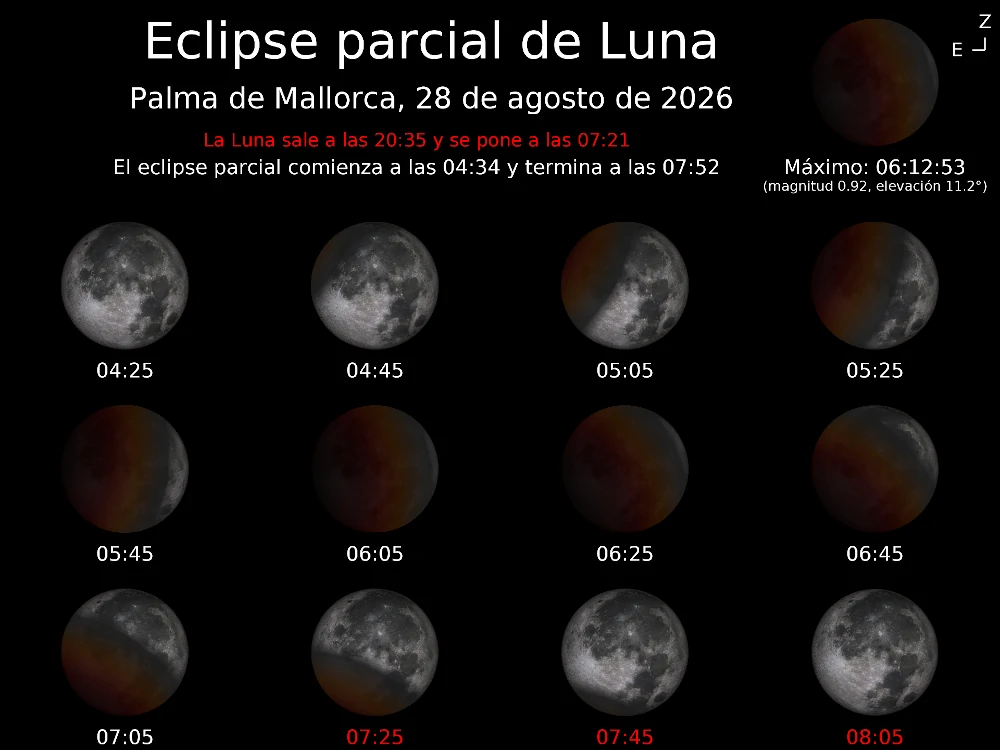
Image: National Geographic Institute (IGN).
However, the end of this phase will not be visible from the Balearic Islands. The IGN states that the Moon will set before the partial eclipse ends in the islands. The same will occur in central and eastern mainland Spain and in Melilla.
In Palma, the Moon will already be quite low in the sky during the most notable stages of the eclipse. At maximum eclipse, it will be just 11.2 degrees above the horizon and will continue to descend until it sets at 07:21.
Where to watch the eclipse from Mallorca
For the best viewing conditions, it is advisable to find a location with a clear view of the western horizon. Buildings, mountains and other obstacles that could block the Moon when it is low in the sky should be avoided.
No special equipment is required to observe the eclipse. Unlike solar eclipses, lunar eclipses can be viewed directly with the naked eye without any risk to eyesight.
During the stages of greatest obscuration, part of the lunar disc may take on reddish or orange tones. This effect occurs when sunlight passes through the Earth’s atmosphere before reaching the Moon’s surface.
An August marked by astronomical events
The partial lunar eclipse comes just over two weeks after the total solar eclipse on 12 August. The Perseids have also made this month one of the highlights of the year for astronomy enthusiasts in the Balearic Islands.
Friday’s phenomenon will therefore offer another opportunity to look to the skies from Mallorca. However, anyone hoping to see the eclipse at its most intense will need to get up early: maximum eclipse will occur at 06:12:53.






Leave A Comment