
Luxury tourism in Mallorca and the Balearic Islands continues to gain strategic importance within the archipelago’s tourism model. Although travellers staying in five-star hotels account for just 7.84% of total tourists, their spending power already represents 27.3% of foreign tourist expenditure in Palma. This is highlighted in the Economic Impact Study of the Luxury Segment in the Balearic Islands, prepared by the University of the Balearic Islands (UIB) and presented today during the professional conference The Impact of Luxury Tourism in the Balearic Islands.
The report also places the estimated economic impact of the luxury segment in the Balearic Islands at €2.3 billion and concludes that this type of visitor contributes 7.75% of the Balearic Islands’ production, 7.14% of added value and 7.35% of employment.
One of the study’s most striking findings is the difference in daily spending between tourist profiles. According to the research, the average daily expenditure of luxury tourists reaches €731, compared with €46 spent on average by foreign tourists overall.
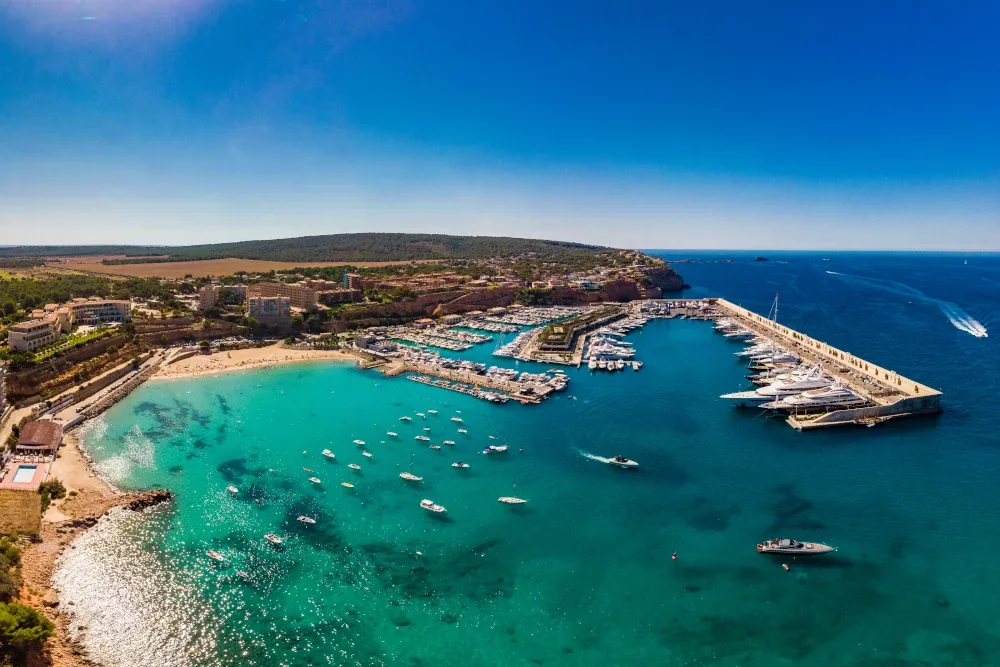
Aerial image of El Toro beach and Port Adriano.
The report presentation took place as part of a conference organised by the UIB, the Ministry of Tourism, Culture and Sports of the Government of the Balearic Islands and Essentially Mallorca, focused on analysing the role of high value-added tourism within the future of the Balearic tourism model.
A model based on value rather than volume
Beyond the figures, the event highlighted the debate surrounding the role that luxury tourism in Mallorca can play in a context shaped by territorial pressure, the need to reduce seasonality and the search for a more sustainable economic model.
The UIB’s Vice-Rector for Scientific Policy and Research, Victor Homar, defended the need to study tourism from a broad and rigorous perspective. “Tourism is one of the main driving forces of the Balearic Islands and it is essential to analyse its economic, social, territorial and environmental impact,” he stated. Homar also added that the report helps to understand “the capacity of luxury tourism to move towards a more qualitative and sustainable model”.
Along the same lines, the Director General of Tourism of the Balearic Government, Miquel Rosselló, stressed that the Balearic Islands “must continue progressing towards a tourism model that prioritises quality, balance and value creation”. According to Rosselló, analysing this segment makes it possible to identify opportunities to strengthen the destination’s competitiveness and consolidate a more differentiated tourism offering.
UIB professor Marta Jacob insisted on the importance of having objective data to guide tourism policies. “It is not only about analysing economic figures, but also about understanding how this segment can influence sustainability, employment, innovation and the competitiveness of the destination,” she said.
Luxury tourism and the circular economy
The study also analyses the relationship between luxury and sustainability. Among its conclusions, it highlights that higher-category establishments show a greater adoption of measures linked to the circular economy and environmental management.
The research also points out that independent hotels tend to be more proactive in terms of energy efficiency, while hotel chains stand out particularly in waste management. The report also underlines that sustainable initiatives gain greater relevance when they become a visible part of the guest experience.
During the conference, the president of Essentially Mallorca, Jesús Cuartero, defended a vision of luxury linked to authenticity and territory. “True luxury in Mallorca cannot be understood without culture, local products and the people who make a unique experience possible,” he stated. According to Cuartero, the island has the capacity to lead “a new way of understanding luxury: more conscious and more connected to the identity of the destination”.






Leave A Comment