
The Balearic Islands’ economy grew by 2.8% in the second quarter of 2026, 0.2 percentage points above the Spanish average and twice the annual growth rate recorded in the European Union. Construction was the most dynamic sector, while rising prices and weak retail trade were among the main causes for concern.
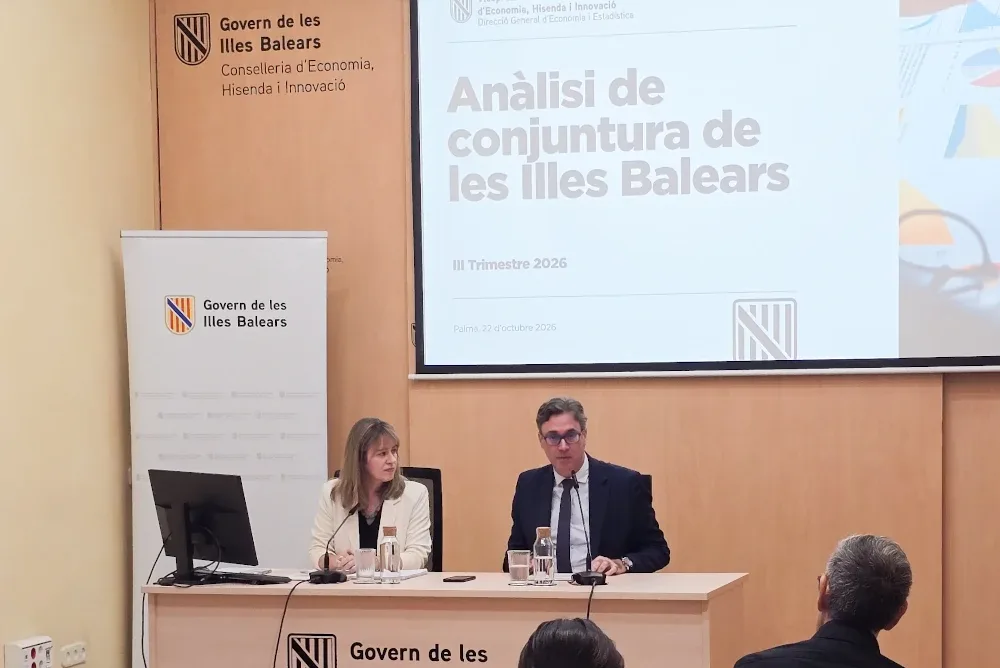
The Director General for Economy and Statistics, Catalina Barceló, and the First Vice-President and Conseller d’Economia, Hisenda i Innovació, Antoni Costa, during the presentation of the third-quarter 2026 report Análisis de coyuntura de las Illes Balears (Analysis of the Economic Situation in the Balearic Islands). Photo: CAIB.
These are the findings of the latest Análisis de coyuntura de las Illes Balears (Analysis of the Economic Situation in the Balearic Islands) report, presented by the First Vice-President and Conseller d’Economia, Hisenda i Innovació, Antoni Costa, and the Director General for Economy and Statistics, Catalina Barceló. The report also confirms a new record for tourist spending and growth in employment, although it raises concerns about long-term GDP per capita trends.
Mallorca leads economic growth in the Balearic Islands
By island, Mallorca recorded growth of 2.9%, followed by Menorca (2.8%) and the Pityusic Islands (2.2%).
Construction led economic activity during the second quarter, with growth of 4.6%. The primary sector also improved, expanding by 2%, while services grew by 2.7% and industry and energy by 1.1%.
This momentum is reflected in housing development. Up to August, housing starts increased by 51.3%, although completed homes fell by 17.5% during the first half of the year.
“In fact, the number of homes receiving building approval has been rising since April, with growth of 10.8% over the past four months, reaching a total of 2,077,” Barceló explained.
Rising prices and declining retail trade concern the Govern
Despite economic growth, rising prices remain one of the main causes for concern. According to the figures presented, prices increased by 5.1% in the Balearic Islands in September, compared with 4.9% across Spain.
“The most worrying figure, without a doubt, is the surge in prices,” Costa warned, noting that “core inflation is also rising (3.3%), while energy products have increased by 19.2%.”
Meanwhile, retail trade has recorded eight consecutive months of year-on-year declines, falling by 1.7% up to August, compared with an increase of 1.3% across Spain. Trade and hospitality have also shown moderate growth, with a combined increase of 1.4%, below the 5.5% recorded nationally.
Tourist spending reaches €18.291 billion
Tourism continues to show positive growth in spending, although the increase in visitor numbers has been more moderate. Up to August, tourist spending reached €18.291 billion, an increase of 5.4%, while arrivals rose by 1.9% to 14.4 million tourists. Average spending per person stood at €1,274.
“It is worth highlighting that overnight stays have fallen by 1.0%, totalling 85.3 million up to August, with an average stay of 5.9 days. Trends also vary between the islands,” Barceló explained.
As for the labour market, the Balearic Islands recorded an average of 613,711 registered workers between January and August, an increase of 3.1%. The services sector accounted for 501,292 workers, while construction recorded 62,934 registered workers “following growth of 5.0%,” Barceló noted. Employment registrations in industry increased by 1.4%, while the primary sector recorded growth of 3.8%.
GDP per capita falls by 2.3% since 2011
The report also examines one of the main structural challenges facing the Balearic Islands’ economy: GDP per capita and productivity trends.
Between 2001 and 2025, real GDP in the Balearic Islands increased by 46.5%, slightly above growth across Spain (44.4%). However, the archipelago experienced much greater population growth over the same period. “We must highlight the considerable demographic pressure experienced by the Balearic Islands in recent years, with a 50% increase since 2001, more than twice Spain’s population growth of 21.1%,” Costa stated.
The Vice-President linked this trend to real GDP per capita: “The Balearic Islands are above the national average, at €28,016 compared with the Spanish average of €26,643. However, it is true that the change since 2011 in our region has been –2.3%, while the rest of Spain has recorded an increase of 19.2%.”
Regarding real productivity per hour worked, the archipelago has recorded growth of 15.4% since 2021, compared with 18.4% across Spain. Nevertheless, Costa highlighted the improvement recorded in 2024, the latest year for which figures have been published. “In Spain, it grew by 1.2%, but in the Balearic Islands the improvement was 3.4%, the highest growth rate in the past 20 years,” the Vice-President stated, comparing this increase with that recorded in 2021, following the COVID-19 crisis.





Leave A Comment