The Centre Cultural la Misericòrdia in Palma opens La ferida de la llengua LA_LANGUE (The Wound of Language) this Tuesday, 8 September, an exhibition by artist Nora Ancarola exploring language, migration and the wounds associated with displacement and exile. Curated by Jaume Reus, the exhibition is part of the Nit de l’Art 2026 programme and will run until 15 November.
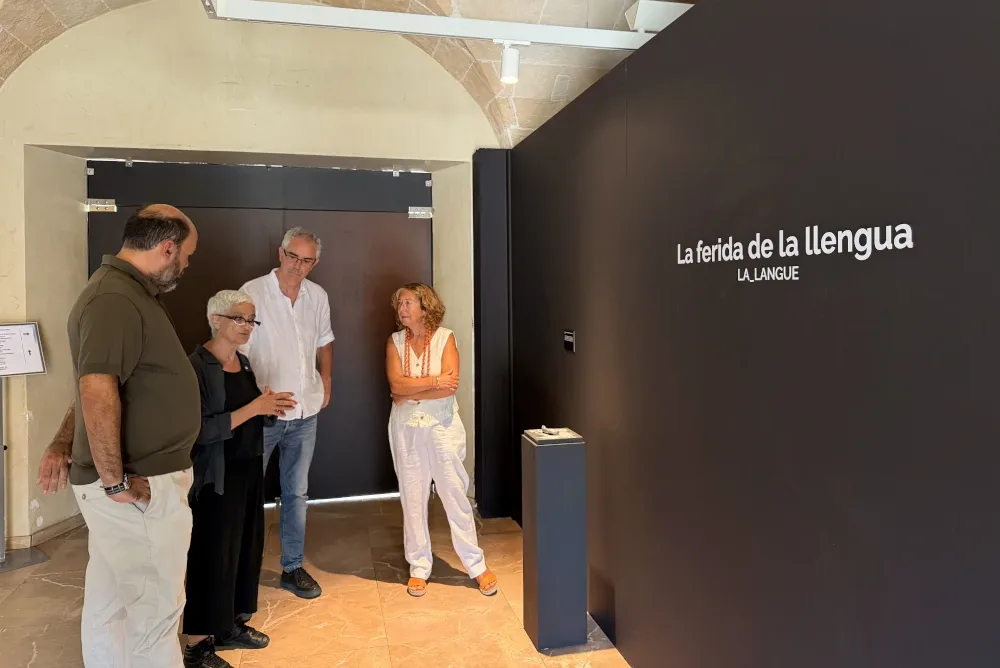
At the centre, visual artist Nora Ancarola and museologist Jaume Reus during the presentation of La ferida de la llengua LA_LANGUE. Photo: Consell de Mallorca.
The exhibition brings together a video installation, a video work, two objects and an intervention in the Pati de les Dones (Women’s Courtyard). Through different artistic languages, Ancarola explores borders, migration and the role of language in situations of displacement.
The exhibition joins the Nit de l’Art 2026 programme
La ferida de la llengua LA_LANGUE forms part of the cultural programme for Nit de l’Art 2026, which takes place in Palma on 19 September. The city’s major annual contemporary art event celebrates its 30th anniversary this year, with exhibitions and projects across galleries, museums and institutions throughout Palma. More information at this link.
Nora Ancarola’s exhibition is one of the projects that La Misericòrdia has added to this year’s programme. The project is curated by Jaume Reus, winner of the first ACCAIB Curatorial Award 2025. Reus received the award for La gratuidad es una agresión – La joven plástica y la renovación de las artes en Mallorca, 1969-1982 (Gratuity is an Aggression – Young Visual Art and the Renewal of the Arts in Mallorca, 1969-1982), presented at Casal Solleric.
The award, promoted by ACCAIB, the Consell de Mallorca and the Institut d’Estudis Baleàrics, included the opportunity to develop an exhibition project at La Misericòrdia. La ferida de la llengua LA_LANGUE has emerged from this initiative.
A reflection on migration and borders
One of the central works in the exhibition is the video installation La_llengua per venir (The Language to Come). The work uses three screens to tell the same events through different visual and oral devices. The piece draws on the text Langue à venir by Jacques Derrida and Hélène Cixous and explores the wounds of language in extreme situations.
The project also draws on figures such as Francesc Tosquelles, Paul Celan, Hélène Cixous and Gloria Anzaldúa. Borders transformed into walls and language in contexts of exile are among the themes running through the work.
The exhibition also includes the video Un hombre a la espalda (A Man on His Back), featuring the testimony of two sub-Saharan teenagers who recount their journey by small boat from Africa to Spain. Their accounts are contrasted with the apparently serene image of the sea.
The exhibition continues with the objects No puedo abrir el puño (I Can’t Open My Fist) and El poder de la imagen (The Power of the Image). The first explores the cold that numbs migrants, while the second focuses on airport photographs documenting passage through police controls under dictatorships, in this case in Argentina.
An intervention in the Pati de les Dones
Nora Ancarola also brings her project to La Misericòrdia’s Pati de les Dones through an intervention using canvases and vinyl lettering. They feature words, questions and headlines related to language and migration.
Concepts such as “stateless”, “outsider” and “tourist” appear alongside questions such as “is there such a thing as a mother tongue?” and “how did you get here?”. The intervention also incorporates references to shipwrecks, connecting the exhibition’s reflections with the current reality of migration.



Leave A Comment