
The Low Emission Zone -Zona de Bajas Emisiones- (ZBE) in Palma will become a reality from 1 July 2025. This project, initially approved in June 2024, aims to reduce pollutant gas emissions and improve air quality in the city. Many questions and answers arise to clear up the most common doubts about Palma’s ZBE. Therefore, this useful guide aims to provide answers to the public.
What is the Low Emission Zone of Palma?
The ZBE is a defined area in the city of Palma where the circulation of the most polluting vehicles will be restricted. These types of zones aim to improve air quality and encourage the use of more sustainable vehicles. In Palma’s case, the ZBE will be fully operational on 1 July 2025.
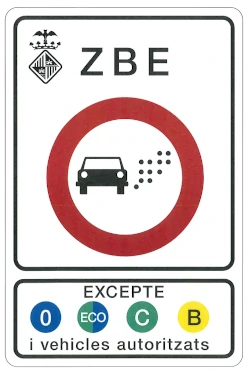
ZBE sign.
Which areas of Palma will be included in the ZBE?
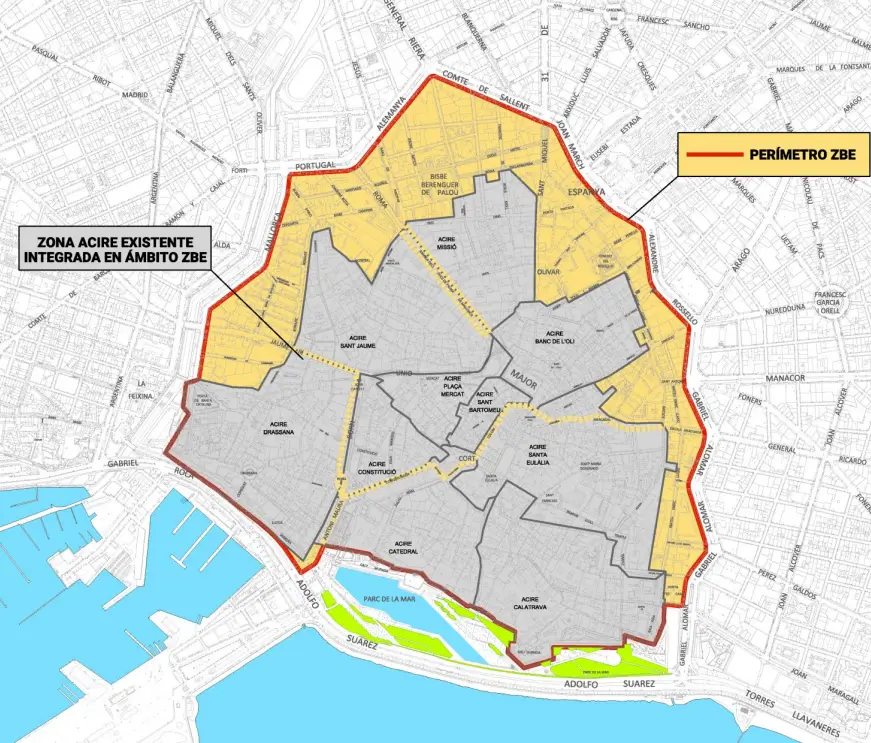
The ZBE will include the most central and traffic-dense areas of Palma. This area mainly covers the old town, or in other words, the entire ring within the avenues. The outer limits of the ZBE are: from l’Avinguda Gabriel Roca, section of the mouth of the Riera, Passeig Mallorca, Avinguda Portugal, Avinguda d’Alemanya, Avinguda Comte de Sallent, Avinguda Gran i General Consell, Plaça d’Espanya, Avinguda Alexandre Rosselló, Avinguda Gabriel Alomar, Avinguda Adolfo Suárez and Avinguda Gabriel Roca.
Which vehicles will not be allowed to enter Palma’s ZBE?
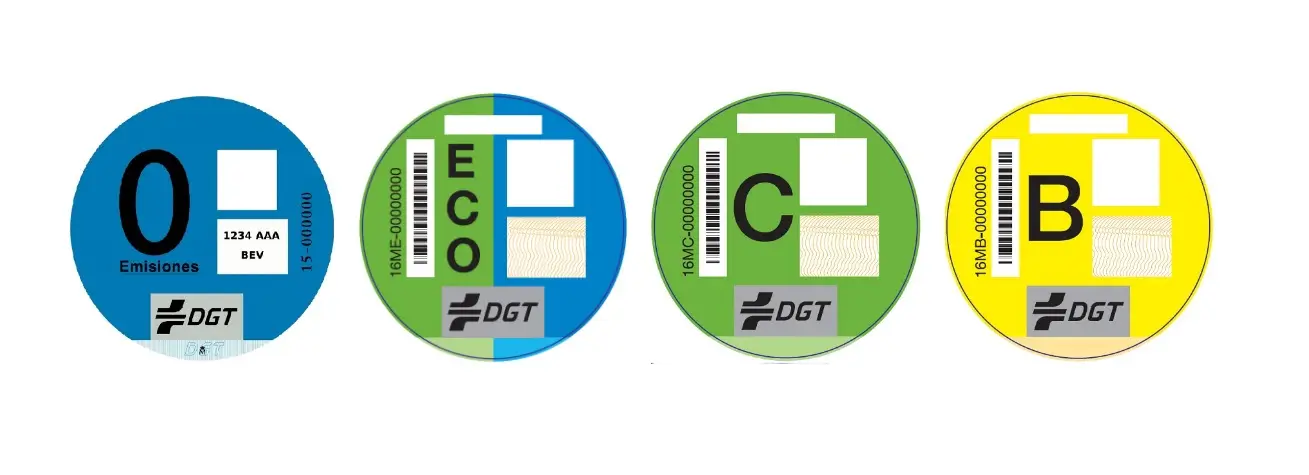
The oldest and highest-emission vehicles will be the first to be restricted. This includes vehicles without an environmental badge from the DGT, such as diesel vehicles registered before 2006 and petrol vehicles before 2000. Vehicles with badges “C”, “ECO” and “zero emissions” will have unrestricted access.
How to know if your car can drive in Palma’s ZBE?
To know if your vehicle can circulate in the ZBE, you must check the environmental badge that corresponds to it according to the DGT classification. You can verify this on the official DGT website or check your registration number on Palma’s ZBE website.
How and where to get the badges for the ZBE?
To obtain the environmental badge necessary to drive in Palma’s Low Emission Zone (ZBE), the process is quite simple. Steps to follow:
- Check your vehicle: Before applying for the badge, make sure your vehicle meets the criteria set by the DGT. Vehicles are classified based on their age and emissions, and only those with an environmental badge can access the ZBE.
- Apply for the badge: You can get the environmental badge in several ways:
- Post offices: You can apply directly at any post office. You will need to present vehicle documents such as the technical sheet and registration certificate.
- Authorised workshops: Some workshops are also authorised to manage badge issuance. Verify that the workshop is an authorised centre by the DGT.
- DGT website: You can also request the badge through the official DGT website. You will need to provide vehicle information and pay a small fee.
- Place the badge: Once you receive the badge, place it in a visible location on your vehicle, preferably on the lower right of the windscreen.
It is important to remember that the badge is essential to drive in the ZBE without incurring penalties, and that obtaining it must be done before the regulation comes into force.
What happens if I enter the ZBE without meeting the requirements?
Driving in the ZBE without the corresponding badge or with a restricted vehicle will result in fines of 200 euros. These fines will be imposed through 16 strategically placed cameras controlling access to the ZBE.
What exceptions will there be for driving in the ZBE?
There will be some exceptions, such as emergency vehicles, public transport, and those transporting people with reduced mobility. Additionally, residents within the ZBE may request special permits if their vehicle does not meet the requirements, although these exceptions will be limited.
The implementation of the Low Emission Zone in Palma aims to take a step towards sustainability and environmental improvement, aligning with European directives for reducing emissions in cities.








Hola, me pregunto qué hacer como turista con coche propio desde otro país de la UE. ¿Qué normas se aplican mientras estamos en la isla?