
The Can Pere Antoni beach in Palma has been the scene of the first discovery of a sea turtle nest in Balearic Islands so far this season. A total of 77 eggs have been counted, marking the second recorded case of nesting at this exact location, following the one registered in 2023.
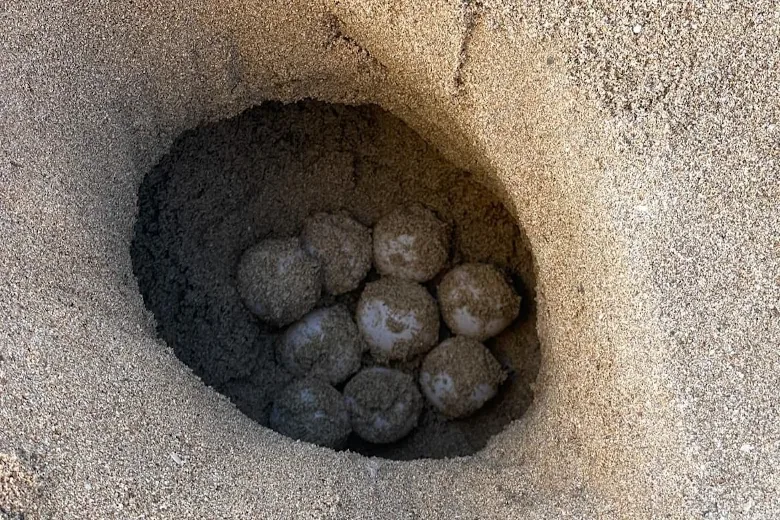
The sea turtle nest found at Can Pere Antoni. Photo: CAIB.
The Ministry of Agriculture, Fisheries and Natural Environment has confirmed the discovery, which took place early Thursday morning. An environmental officer from the Ministry for the Ecological Transition and the Demographic Challenge identified a distinct track in the sand, typical of sea turtle nesting (Caretta caretta). This prompted the activation of the Species Protection Service protocol, managed by the Marine Fauna Department of COFIB.
The investigation confirmed the presence of the nest and enabled the counting of eggs. Of these, 10 were transferred to the Aula de la Mar centre in Palma, where they will be artificially incubated for about two months to maximise their chances of survival. The remaining 67 eggs were relocated to a safer area on the same beach, away from the risk of flooding. The new site has been marked and protected, and it will be monitored via cameras and supervised by COFIB staff.

The nest was found on Can Pere Antoni beach in Palma. Photo: CAIB.
The discovery was made possible thanks to the collaboration of several organisations, including the Palma Aquarium Foundation, Palma City Council, the Ministry for the Ecological Transition, Tragsatec, and COFIB itself.
Public involvement in detecting sea turtle nests in the Balearic Islands
Regional Minister Joan Simonet emphasised the importance of public involvement in identifying signs of turtle nesting. “In this case, the turtle itself wasn’t seen, but thanks to the track left in the sand, swift action was possible,” he said. He also reminded the public that if a suspicious track is found on the beach, it should not be stepped on or touched, and people should immediately contact 112 to activate the relevant protocol.
Guillem Félix, coordinator of marine fauna at COFIB, highlighted that Balears is currently in the middle of nesting season. “This nest is further proof that climate change, and specifically the warming of Mediterranean waters, is shifting nesting areas westward — areas that used to be mainly in the eastern Mediterranean,” he explained. Félix added that more nesting attempts may occur across other parts of the Balearic coastline in the coming weeks, underlining the need to remain vigilant.
Vulnerable species
The Caretta caretta is a vulnerable species whose presence on Balears’ coasts remains relatively rare, although a gradual increase in nesting events has been observed in recent years. Monitoring these nests is key to ensuring their conservation and understanding how their reproductive behaviour evolves in the context of climate change.





Leave A Comment