
The Mallorca population 2026 stands at 978,465 residents as of 1 January, according to provisional data from the Continuous Population Statistics (ECP) published by Spain’s National Statistics Institute (INE). This represents an increase of 7,397 people compared with the previous year, a year-on-year rise of 0.76%. With these figures, Mallorca remains the main demographic centre of the archipelago, accounting for around three in every four residents in the Balearic Islands.
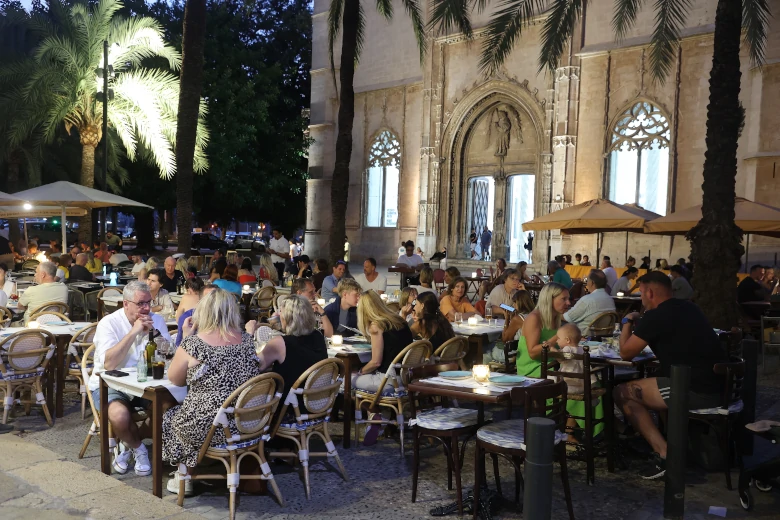
Busy terraces in Plaça de Sa Llotja, one of Palma’s liveliest social and tourist areas. Photo: Teresa Ayuga.
The gender split remains almost even, with a slight female majority. In total, 485,263 residents are men (49.6%) and 493,202 are women (50.4%), making women the slightly larger group in the island’s population.
Nationality and place of birth
The Mallorca population 2026 is still predominantly Spanish by nationality, although the foreign population continues to make up a significant share of residents. Specifically, 769,369 people hold Spanish nationality (78.6%), compared with 209,096 foreign nationals (21.4%). In practical terms, this means more than one in five residents on the island is a foreign national.
Looking at place of birth provides an even clearer picture of the impact of migration. Of the total resident population, 695,291 people were born in Spain (71.1%), while 283,174 residents were born abroad (28.9%). This means almost three in every ten residents in Mallorca were born outside Spain, a proportion notably higher than the share of foreign nationals by nationality.
This difference reflects the large number of residents of foreign origin who have already acquired Spanish nationality, a demographic feature that is well established on the island.
Age structure of the Mallorca population 2026
The age profile shows that Mallorca’s population is strongly concentrated in adult age groups. The largest group is 45 to 59 years, with 233,089 residents, representing 23.8% of the total. This is followed by those aged 30 to 44, with 209,576 residents (21.4%), and 15 to 29, with 174,117 residents (17.8%).
Overall, residents aged 30 to 59 total more than 440,000 people, underlining the predominance of the island’s central working-age groups.
Breakdown by broad age bands
- Under 15s: 128,520 (13.1%)
- Aged 15 to 29: 174,117 (17.8%)
- Aged 30 to 44: 209,576 (21.4%)
- Aged 45 to 59: 233,089 (23.8%)
- Aged 60 to 74: 151,874 (15.5%)
- Aged 75 and over: 81,289 (8.3%)
Key facts: Mallorca population 2026
- Total population: 978,465 residents
- Annual growth: +7,397 residents (+0.76%)
- Majority sex: Women (50.4%)
- Foreign nationals: 209,096 residents (21.4%)
- Born abroad: 283,174 residents (28.9%)
- Largest age group: 45 to 59 (23.8%)
- Working-age core (30–59): Over 440,000 residents
Population in the rest of the islands
Beyond Mallorca, the demographic picture varies across the rest of the Balearic Islands. Eivissa reaches 166,020 residents as of 1 January 2026, with a slight male majority: 84,399 men (50.8%) compared with 81,621 women (49.2%). By nationality, 118,878 residents hold Spanish nationality (71.6%), while 47,142 are foreign nationals (28.4%), one of the highest proportions in the archipelago.
Menorca records 103,117 residents, with an almost even split by sex: 51,405 men (49.9%) and 51,712 women (50.1%). The population with Spanish nationality totals 88,485 (85.8%), while 14,632 residents are foreign nationals (14.2%), reflecting a more moderate migrant presence.
Formentera, meanwhile, stands at 11,943 residents, with a slightly more male-leaning structure: 6,152 men (51.5%) and 5,791 women (48.5%). The island also has the highest relative share of foreign nationals, with 3,461 residents (29.0%), compared with 8,482 residents with Spanish nationality (71.0%).




Leave A Comment