
750th anniversary of the death of Jaume I the Conqueror

On 27 July 2026, it will be 750 years since the death of Jaume I the Conqueror. The figure of the man who was king of Aragon, Valencia and Mallorca, count of Barcelona and Urgell, and lord of Montpellier was crucial for the history of Europe and, in particular, for the future of Spain.
He had conquered Mallorca in 1229, when he was only twenty-one years old. He turned the island into a new kingdom, granting it a foundational constitution, the Charter of Liberties and Privileges, and an institution to govern it, the University of the City and Kingdom of Mallorca. The first decades following the conquest were, in many ways, rather chaotic and unstable, but from the second half of the 1260s onwards, an emerging bourgeois class managed to stabilise the new kingdom and even make it flourish economically. The king was one of the main beneficiaries of this new situation.
Throughout the long reign of Jaume I, one question constantly troubled his sons and the court: his will. At the age of thirteen, Jaume I had married Leonor of Castile, daughter of Alfonso VIII of Castile and Eleanor Plantagenet. The wedding -one of the many attempts made by medieval Hispanic kings to unite ancient Hispania under a single ruler- took place in Ágreda (Soria). From this first marriage was born the infante Alfons, who thus became the heir to the Crown of Aragon. Jaume I married again in 1235, this time to Yolanda of Hungary, daughter of Andrew II of Hungary and Yolanda of Courtenay. Eight children were born from this marriage: Violant -who married Alfonso X of Castile-; Constança -who married the infante Manuel of Castile-; Pere -future king of Aragon-; Jaume -future king of Mallorca-; Elisabet -who became queen of France, wife of Philip III of France and mother of Philip IV of France and Charles, Count of Valois-; Sanç -a cleric, who became Archbishop of Toledo-; Maria -a nun-; and Sança -who married her brother-in-law Manuel of Castile.
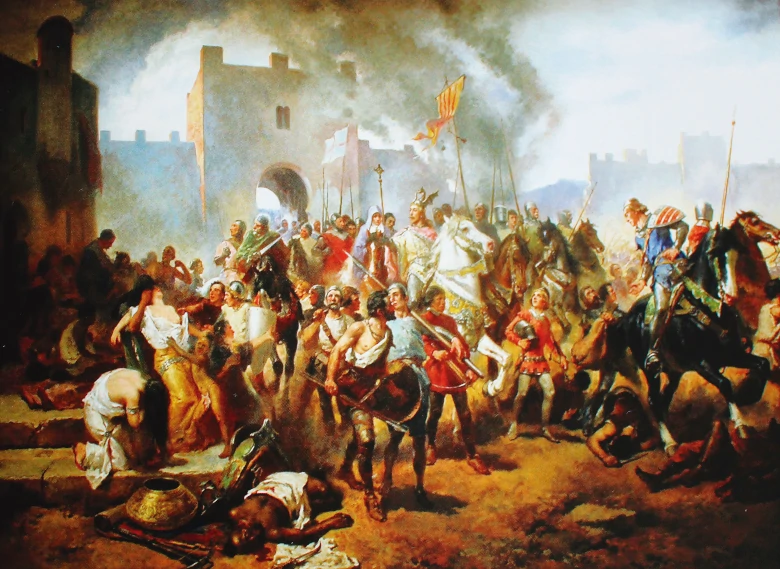
Entry of Jaume I into Madina Mayurqa, a work by the Mallorcan artist Faust Morell i Bellet, created in 1903.
Throughout his life, king Jaume I signed several wills in which he varied the distribution of his territories among his first three sons: Alfons of Aragon and Castile, and Pere and Jaume, of Aragon and Hungary. The death of his firstborn, the infante Alfons, in 1260 simplified the division into two parts. Despite the changes to the will, the share allotted to his third son never changed much. In fact, in 1256 Prince Jaume was already governing from the island those territories that would later form his Crown. He did so in his father’s name and signed official documents as heir to the kingdom of Mallorca and Montpellier, and to Roussillon, Cerdanya and Conflent. During those years, he also began to use his personal heraldry: a gold shield with two red pales, “so that all the aforementioned things may have greater firmness, with our own seal we cause this present charter to be sealed”.
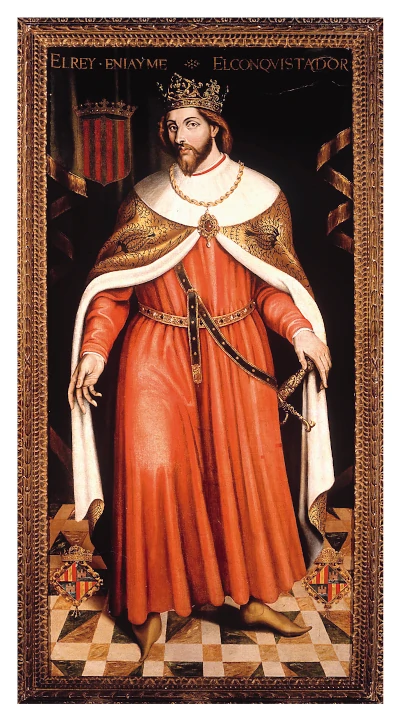
Portrait of Jaume I, 16th century.
In 1272, Jaume I signed his final will: to Pere he would give the Crown of Aragon, which would consist of the kingdom of Aragon, the kingdom of Valencia and the Catalan counties except for those north of the Pyrenees; while to Jaume he would give a new Crown made up of territories not inherited directly from his father, Pere II the Catholic, that is, the Balearic Islands, the northern Catalan counties inherited from his uncle Nuno Sanç -Roussillon, Cerdanya, Vallespir, Conflent and Capcir- and the lands in Languedoc consisting of the lordship of Montpellier -inherited from his mother- and the viscounties of Omeladès and Carladès. Jaume I decreed in his will that the territories of the Crown of Mallorca should “be preserved perpetually in their entirety and under the authority of their monarchs”, those of the Royal House of Mallorca.
In 1276, at the age of sixty-eight, lying on his deathbed, king Jaume I reminded his two sons that they must reign rightly, according to what was established in the last of his many wills: “Fair sons, think on governing the land and love your people, and be merciful, and love and honour the barons and knights […] and maintain the land with righteousness and justice.”
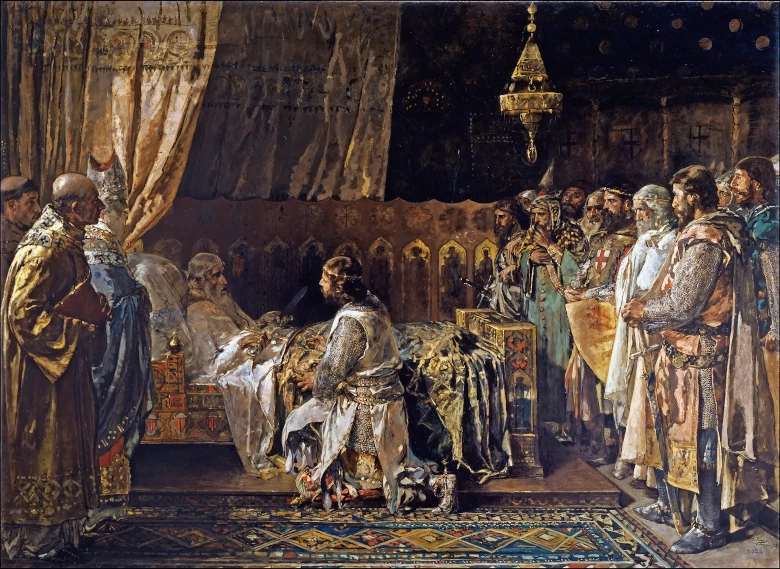
The final moments of King Jaume the Conqueror as he hands his sword to his son Peter III of Aragon. Ignasi Pinazo Camarlench, 1881.
Jaume II was crowned king in Mallorca on 12 September 1276, beneath the vaults of the church of Santa Eulàlia in Palma, in a ceremony “of great joy and great celebration”. From the earliest days of his reign, the Mallorcan monarch was aware that his domains were coveted by the king of France and, above all, by his brother Pere III the Great. The king of Mallorca was certain that the king of Aragon, eager to extend his domains, would not permit divisions within their lineage. Events soon proved him right, for his brother did not take long to break the will of their father, Jaume I, and on 20 January 1279 he forced his brother, the king of Mallorca, to sign a treaty of vassalage, by which he had to render him homage and fealty. Thus began the tortuous history of the Royal House of Mallorca, represented by Kings Jaume II, Sanç I and Jaume III.
NOTE: Quoted passages taken from the text of the Llibre dels fets (Book of Deeds), by Jaume I.
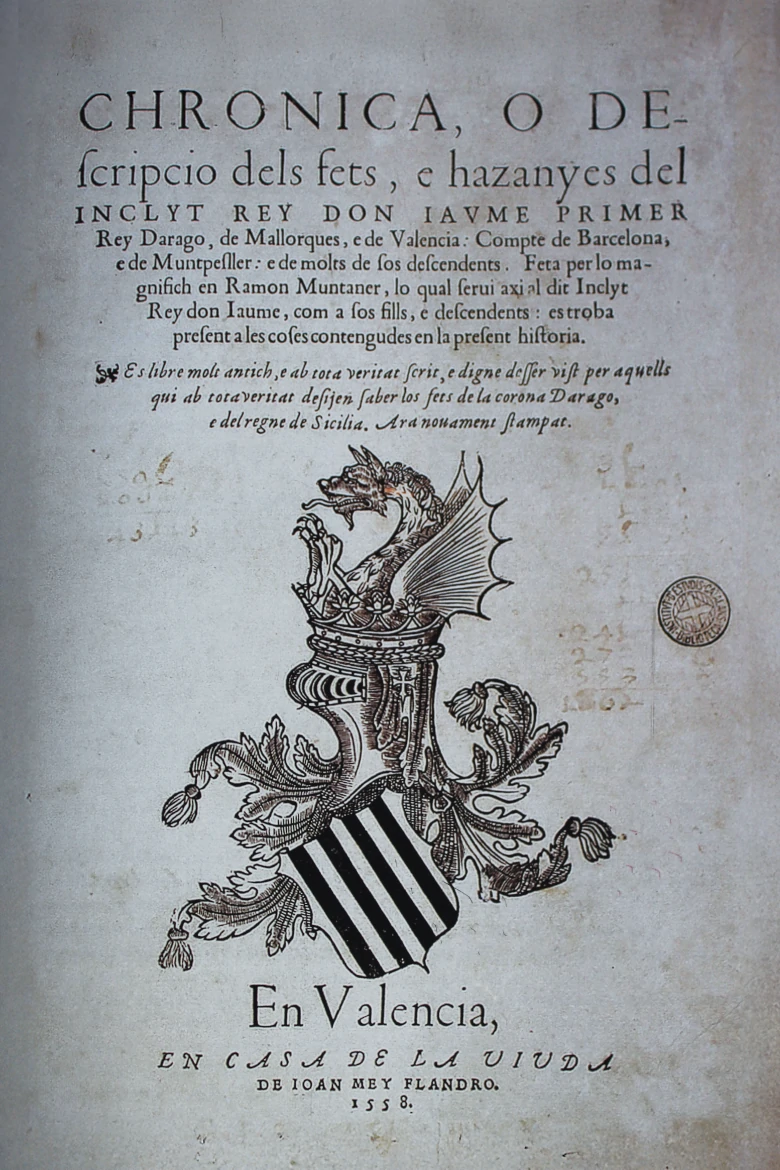
Cover of the 1558 edition of Chronica dels fets de Jaume I, written by Ramon Muntaner.





Leave A Comment