
At least 447 women are victims of sexual exploitation in Palma, according to the latest report Identification of cases of trafficking for the purpose of sexual exploitation (TFES), presented by the Palma City Council on the occasion of the International Day against Sexual Exploitation and Human Trafficking, which will be observed tomorrow, 23 September.
The document, prepared by the Technical Unit for Equality, shows that one in three women in prostitution presents clear signs of exploitation or trafficking.
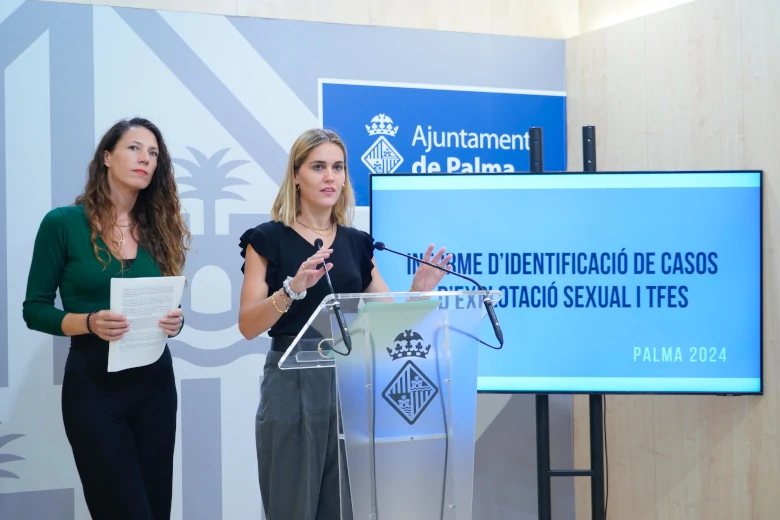
The Deputy Mayor and Councillor for Social Services, Education, Citizen Participation, Youth and Equal Opportunities, Lourdes Roca (right), during the presentation of the report. Photo: Palma City Council.
The Deputy Mayor and Councillor for Social Services, Education, Citizen Participation, Youth and Equal Opportunities, Lourdes Roca, highlighted the importance of this work:
“Our firm commitment is to eradicate this scourge, opting for a comprehensive approach that combines close and continuous care, coordination between services and public policies that place the protection of victims at the centre, together with a clear commitment to awareness-raising and prevention.”
Profile of the victims
The report details that the majority profile of the victims corresponds to young women, foreign nationals and in an irregular administrative situation. 74% have family responsibilities, and 59% support two or more dependants.
By age, the most affected groups are those aged 25 to 34 years (40%) and 35 to 44 years (32%), with an average age of 34.7 years.
Where sexual exploitation in Palma takes place
Sexual exploitation in Palma mainly occurs in off-site settings, which makes detection of cases more difficult:
- Private homes: 64%
- Outcall services: 14%
- Streets: 12%
- Clubs: 8%
- Webcam: 2%
“These heterogeneous spaces are more difficult to detect, which increases the need to strengthen identification mechanisms,” stressed Roca.
Access to resources and support for victims
The report also highlights significant support work. 92% of victims have accessed social resources such as financial assistance or accommodation. In addition, 47% received healthcare, 43% training and employment guidance, 25% legal support and 23% psychological assistance.
The councillor expressly thanked those who made this work possible:
“I want to acknowledge the effort of the municipal technical teams and the organisations that have been alongside the victims, supporting and listening to them. Thanks to this coordinated effort many women have managed to escape these situations and begin their recovery process.”
Finally, Roca condemned any form of violence against women, reaffirming the “firm commitment of the City Council to make Palma a city that defends the freedom, equality and dignity of all people”.








Leave A Comment