
Three out of four residents of the Balearic Islands (75.6%) believe that too many tourists arrive on the islands, a sentiment that reaches its peak in Mallorca, where 78.5% of inhabitants say the arrival of visitors is excessive, according to the 2024 Residents’ Opinion Survey on Tourism in the Balearic Islands, carried out by the Agència d’Estratègia Turística de les Illes Balears (AETIB). By comparison, in Eivissa 66.6% of respondents perceive tourist saturation; in Menorca, 65.6%; and in Formentera, 53.5%.
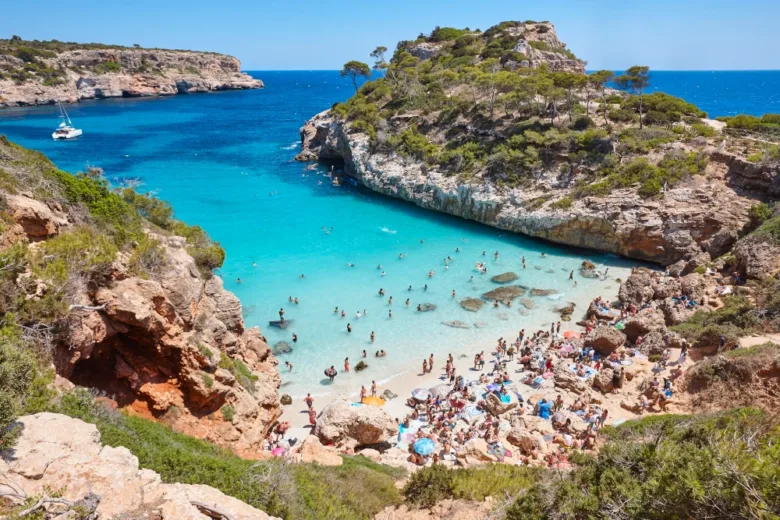
Es Caló des Moro is a clear example of tourist overcrowding in Mallorca.
Another noteworthy finding of the study is that, although tourism remains the economic engine of the islands, 71.1% of those with economic ties to the sector believe that too many tourists arrive, or that they arrive in excessive numbers at certain times of the year. This percentage rises to 82% among those not economically linked to the sector, highlighting that concerns about saturation affect the majority of the population.
Study methodology
The main objective of the survey was to understand how Balearic residents assess possible measures, such as limiting the number of visitors or restricting holiday rentals, and the impact of tourism on their quality of life. In total, during the past month of October, 2,008 people aged over 18 were interviewed, all with permanent residence in the Balearic Islands for at least the past year: 738 in Mallorca, 460 in Menorca, 460 in Eivissa and 350 in Formentera. It is worth noting that the sample in Formentera is particularly significant, as it represents a high proportion of the island’s population compared with the others, offering a very representative view of local perception.
Restricting holiday rentals and hire vehicles, the most supported measures
Infographics: AETIB.
-
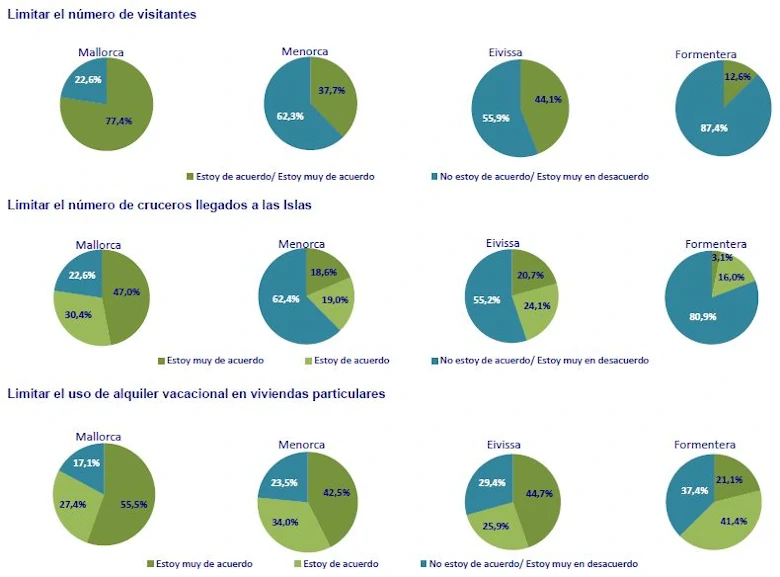
Limiting the number of visitors: 69.1% of Balearic residents agree with this initiative. Mallorca stands out with 77.4%, as being the island that receives the most tourists, its residents experience saturation more intensely and consider visitor caps especially necessary to preserve quality of life and avoid demographic pressure. The island’s year-round tourism also plays an important role.
-
Limiting the number of cruise ships arriving in the islands: 69.2% of residents support this measure. By island, support is distributed as follows: Mallorca, the main receiver of cruises in the Balearics, leads with 77.4%, followed by Eivissa 44.8%, Menorca 37.6% and Formentera 19.1%. Reducing cruise arrivals would help avoid overcrowding and peaks of tourist pressure in short periods, mainly in Palma.
-
Restricting holiday rentals in private homes: 80.5% of residents support this proposal, the most popular across the archipelago. By island: Mallorca 82.9%, Menorca 76.5%, Eivissa 70.6% and Formentera 62.6%. These figures clearly reflect that tourist gentrification and the shortage of housing for locals are among the main concerns for Balearic residents.
-
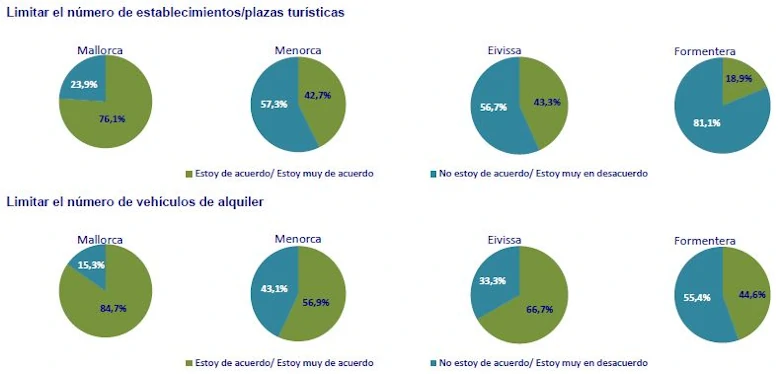
Limiting the number of tourist establishments/bedplaces: 68.4% of residents support this initiative. It is seen as a tool to balance the tourism offer with the capacity of services and the environment, reducing the impact on infrastructure and natural resources.
-
Limiting the number of hire vehicles: 79.6% of residents agree with this measure, the second most supported after restrictions on holiday rentals. Reducing the number of rental cars would help decrease congestion on roads and in tourist areas, improving mobility and safety.
The impact of tourism on residents’ quality of life
The study also captures the perception of various effects of tourism on the islands, showing broad consensus on some key aspects:
-
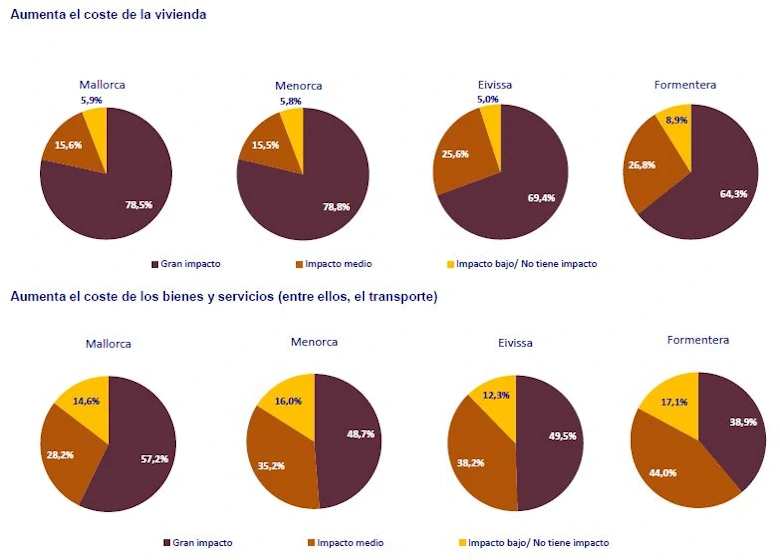
Increases the cost of housing: In the Balearic Islands, 77.2% of respondents consider that tourism has a major impact on housing prices, while 17.1% rate it as a medium impact and only 5.8% believe it is low or negligible. By island, the percentages for major impact reach 78.8% in Menorca and 78.5% in Mallorca, with all territories above 64%. These results reflect that access to housing has become one of the main concerns of Balearic society, with growing difficulties for many residents to access an affordable home.
- Increases the cost of goods and services (including transport): 55.3% of respondents in the Balearics perceive a major impact in this area, 30.3% rate it as medium impact, and 14.4% consider it low or negligible. In Mallorca, the major impact rises to 57.2%. These findings suggest that tourism also affects the cost of everyday life, from basic products to mobility.
-
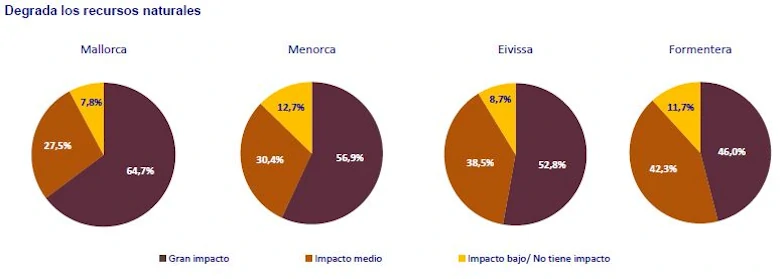
Degrades natural resources: 62.3% of residents in the Balearics consider that tourism has a major impact on natural resources, 29.3% indicate a medium impact, and only 8.4% see it as low or nonexistent. In Mallorca, the percentage for major impact rises to 64.7%, highlighting social sensitivity to the environmental effects of tourism activity.
-
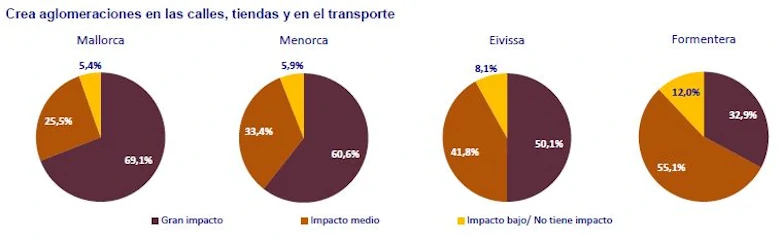
Creates overcrowding in streets, shops and public transport: 65.5% of respondents in the Balearics believe tourism causes a major impact on the saturation of public spaces, 28.6% perceive it as medium impact, and 5.9% rate it as low or negligible. In Mallorca, where the highest volume of arrivals occurs, the major impact reaches 69.1%, whereas in Formentera it drops to 32.9%, reflecting that tourist pressure is not perceived with the same intensity across all islands.
In conclusion, the survey reveals a widespread perception of saturation and strong support for control measures, pointing to the need to move towards a tourism model change that ensures sustainability and preserves residents’ quality of life.







Leave A Comment