
The future Palma Botanical Garden will have one of its main locations in the Parc de Ses Vies, following the formalisation by the Palma City Council and the Consell de Mallorca of the free transfer of use of a 13,000-square-metre publicly owned plot located in this strategic area of the city.
The agreement was signed by the Mayor of Palma, Jaime Martínez Llabrés, and the President of the Consell de Mallorca, Llorenç Galmés, and will enable this space to be integrated into the development of the Palma Botanical Garden, one of the flagship projects of the current municipal term.
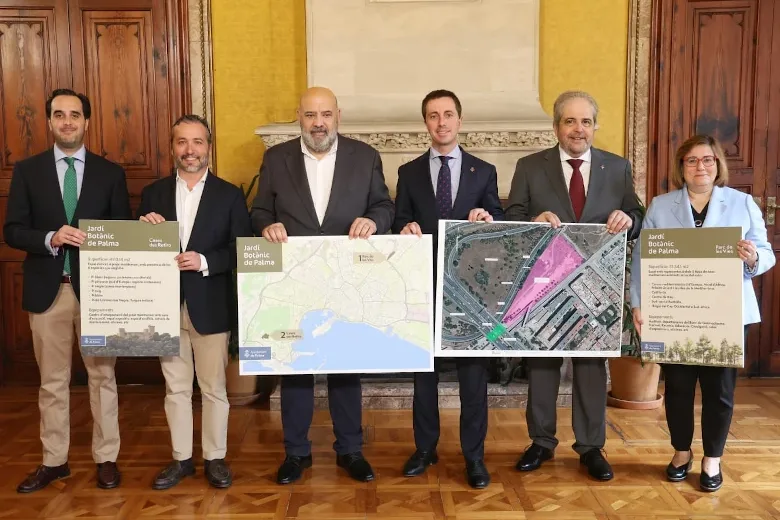
Jaime Martínez Llabrés and Llorenç Galmés (centre), together with other authorities, present the location of one of the Palma Botanical Garden’s sites. Photo: Consell de Mallorca.
The land, owned by the Consell de Mallorca, is located between the Vía de Cintura (Ma-20), the Inca motorway (Ma-13), the Palma–Manacor railway line and the na Bárbara stream. These are remnants of former road infrastructures that are now being incorporated into a project focused on urban renaturalisation and scientific outreach.
A Palma Botanical Garden with two complementary locations
The Palma Botanical Garden will be structured around two sites that complement each other. At the Parc de Ses Vies, the scientific and cultural dissemination component will be concentrated, featuring a representative garden of flora from all regions of the world with a Mediterranean climate, such as the Mediterranean Basin, California, central Chile, south-western Australia and South Africa’s Western Cape.
The second location will be Ses Cases des Retiro, a public estate situated next to the Bellver Forest, where the City Council has already approved a basic rehabilitation project valued at 2 million euros. This site is set to house a Mediterranean pine forest interpretation centre and to restore the historic building for public use, thereby strengthening the city’s cultural, heritage and environmental offering.
The project also includes the forthcoming launch of an architectural design competition and forms part of a broader city strategy aimed at the renaturalisation of urban spaces and the promotion of green infrastructure, alongside initiatives such as the Metropolitan Forest and the acquisition of Son Quint.
One of the most important and emblematic projects of this term
Jaime Martínez Llabrés stated that “this agreement is a clear example of the importance of institutional cooperation in advancing projects that are beneficial not only for Palma, but for the island as a whole”, and noted that this transfer represents “a decisive step in one of the most important, emblematic and transformative projects of this term”.
For his part, Llorenç Galmés pointed out that it is “a space that will be enjoyed by all residents of Mallorca and our visitors” and that it “enhances the city’s environmental heritage”. Galmés added that initiatives of this kind reinforce the aim for Palma’s architectural, cultural and environmental heritage to be recognised by UNESCO, and for the city to aspire to become European Capital of Culture in 2031.




Leave A Comment