
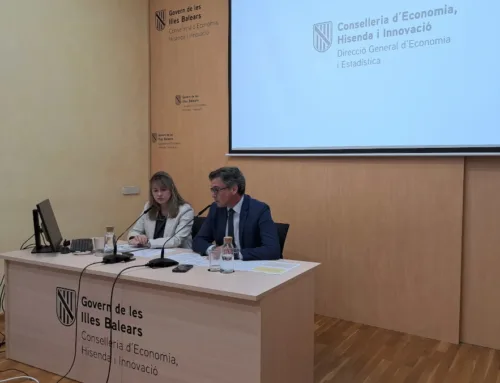
Tourist spending in the Balearic Islands in 2025 reached a record high of €23.406 billion, representing a year-on-year increase of 4.7%, according to the February edition of El Moment Econòmic de les Illes Balears. This rise consolidates a model focused on higher value per visitor, although tourist arrivals slowed their growth rate.
Average spending per person stood at €1,228 (+2.9%), while daily spend reached €198, up 5.7% compared with the previous year.
Tourist spending in the Balearic Islands in 2025 grew faster than visitor arrivals
While spending hit a record, the number of tourist arrivals rose by just 1.7%.
Performance differed by origin:
- International tourists: +2.6% (15.7 million)
- Domestic tourists: -2.3% (3.3 million)
By island, the domestic market showed notable differences:
- Menorca: +4.5%
- Mallorca: -0.6%
- Pitiüses: -10.3%
These figures highlight the stronger contribution of international visitors to the growth in tourist spending in the Balearic Islands in 2025.
Balearic GDP records four consecutive years of growth above Spain
According to the official revision by Spain’s National Statistics Institute (INE), Balearic GDP grew by 4.2% in 2024, outperforming the national average growth of 3.5% and marking four consecutive years above the Spanish figure.
The services sector once again acted as the main economic driver.
The services sector led growth in 2025
Turnover in the services sector in the Balearic Islands posted an average increase of +6.9%, compared with +4.8% nationally.
By activity:
- Professional activities and hospitality drove annual growth.
- In December, transport stood out (+15.3%).
- Hospitality showed a more moderate increase (+1.0%).
Air traffic set a new record with 23.6 million passengers (+1.3%), while maritime traffic fell by 1.1%.
Housing, industry and employment reinforce the economic cycle
In 2025, the islands exceeded 4,800 housing permits for the first time since 2008, with a year-on-year rise of 29.1%.
Industrial output grew by 4.0%, above the Spanish total (+1.3%), driven by durable consumer goods, capital goods and energy.
In the labour market, employment affiliation rose by 2.5% in January 2026, with similar gains in the general regime (+2.5%) and among the self-employed (+2.3%).
Inflation moderates at the start of 2026
2026 began with a slowdown in inflation in the Balearic Islands. The headline rate stood at 2.4%, very close to the Spanish average (2.3%), while core inflation reached 2.7%, moving above the headline rate after three quarters below it.





Leave A Comment