
Emaya has managed to reduce water losses in the Palma network from 25% to 16%, the lowest figure on record. This improvement represents a saving of 3.6 cubic hectometres, equivalent to half of the Gorg Blau reservoir.
The progress is due to the renewal of water networks and the installation of digital flow meters in the distribution network, according to the Palma City Council. These measures are part of Emaya’s modernisation plan and the European funding from the PERTE for the Digitalisation of the Water Cycle.
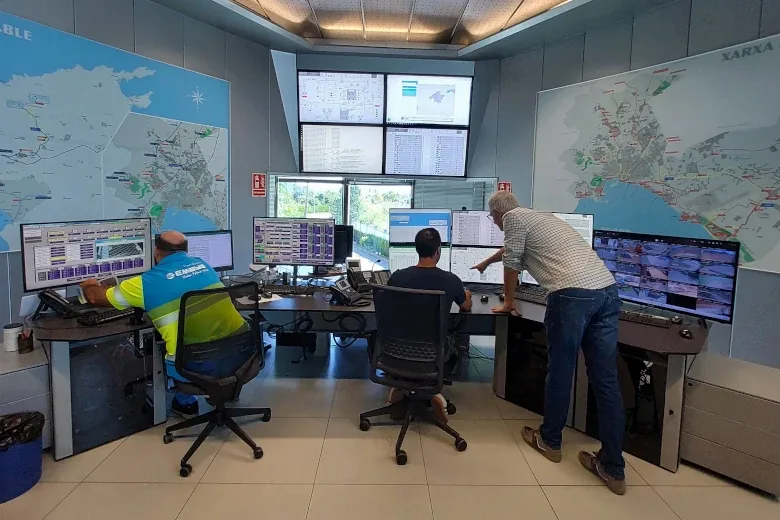
Emaya control centre in Son Tugores. Photo: Palma City Council.
Water losses in cities are usually caused by pipe leaks, metering errors, or unauthorised consumption. Replacing traditional mechanical meters with digital meters has allowed for more precise and efficient monitoring.
A Sectorised Water Network in Palma
The Palma water supply network exceeds 1,100 kilometres of pipes, a similar size to the city of Valencia. To manage this network, the city is divided into 600 micro-sectors of between 2 and 5 kilometres.
Thanks to this organisation and digital monitoring systems, Emaya can detect leaks in just two to three days. In some cases, even in less than 24 hours.
Detection combines technology and fieldwork. When an anomaly is detected, technicians go to the area to confirm the source of the problem. They use state-of-the-art acoustic devices, including highly sensitive microphones, noise-cancelling headphones, and screens that display the vibrations of water under pressure.
This technique makes it possible to listen to water underground and locate hidden leaks without breaking the pavement. This reduces intervention times and avoids unnecessary works.
The result: faster repairs, lower costs, and less disruption for citizens.
Improved Network Performance
Currently, more than 60% of Palma’s drinking water network is sectorised with flow meters recording data every 15 minutes. The information is sent automatically to Emaya’s control centre, which operates 24 hours a day.
This system has allowed a further 9% reduction in losses and increased the network’s efficiency from 75% to 84%.








Leave A Comment