
Don’t be alarmed if, while strolling through Palma’s Parc de la Mar, you spot the silhouette of a crocodile-like mythical creature emerging from the water. It’s not the feared Drac de na Coca returning to terrify the people of Palma once more, but rather the new sculpture by artist Ricard Chiang, which now forms part of the city’s landscape.
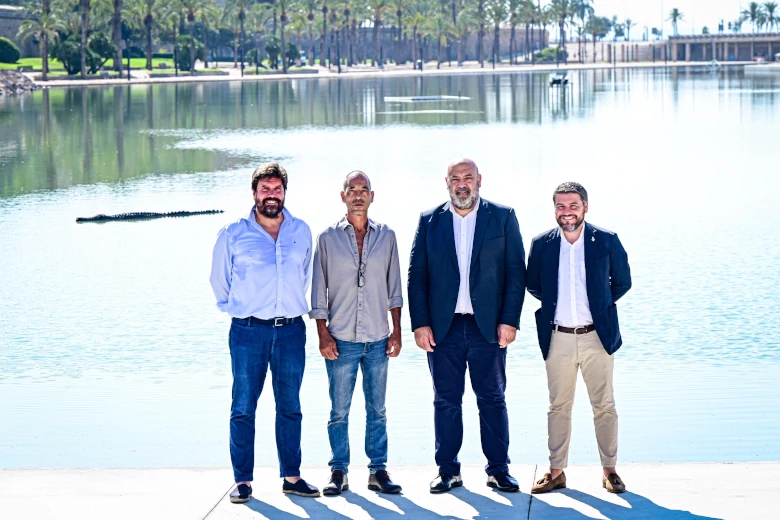
The general coordinator of Culture and Tourism, Fernando Gómez de la Cuesta; the artist Ricard Chiang; the mayor of Palma, Jaime Martínez Llabrés; and the first deputy mayor and councillor for Culture, Javier Bonet, pose in front of the sculpture of El Drac de na Coca. Photo: Ajuntament de Palma.
The piece, measuring three metres in length and weighing around 150 kilos, has been installed in the park’s lake and donated to the city by the artist himself. The sculpture is made from a special mortar resistant to seawater. Its hollow structure allows it to float steadily, anchored by stainless steel chains to keep it in place.
Thanks to Ricard Chiang
The mayor of Palma, Jaime Martínez Llabrés, expressed his gratitude for Chiang’s generous contribution: “Thanks to this proposal, the figure of the Drac de na Coca is brought back to become part of the city’s image, incorporating this piece into Palma’s sculptural heritage, as the city aims to become the European Capital of Culture in 2031.” According to Martínez Llabrés, the sculpture combines “culture, tradition and history, and recalls the 18th-century legend of the dragon that roamed the city’s sewers.”
Also present at the sculpture’s unveiling were the first deputy mayor and councillor for Culture, Javier Bonet; the general coordinator of Culture and Tourism, Fernando Gómez de la Cuesta; and the artist himself, Ricard Chiang.
The legend of the Drac de na Coca
The story of the Drac de na Coca dates back to 1776, when rumours began to spread that a huge dragon was prowling around La Portella street, near Palma Cathedral. Local residents reported strange noises at night, and some even claimed the beast had devoured children and beggars.
The situation escalated to the point where a young knight, Bartomeu Coch, decided to confront the fearsome creature on his way to visit his fiancée — hence the nickname “na Coca”. With great courage, he managed to slay the beast, which turned out to be a crocodile that had grown hidden in the city’s sewers.
Due to its rarity, Captain Coch’s family had the creature embalmed and kept it for years, until they donated it to the Diocesan Museum of Palma, where it has been on display since the early 20th century. In addition, a sculpture of the reptile adorns the façade of the building opposite the museum, reminding passers-by that, in Palma, even legends have a place in history.




Leave A Comment