
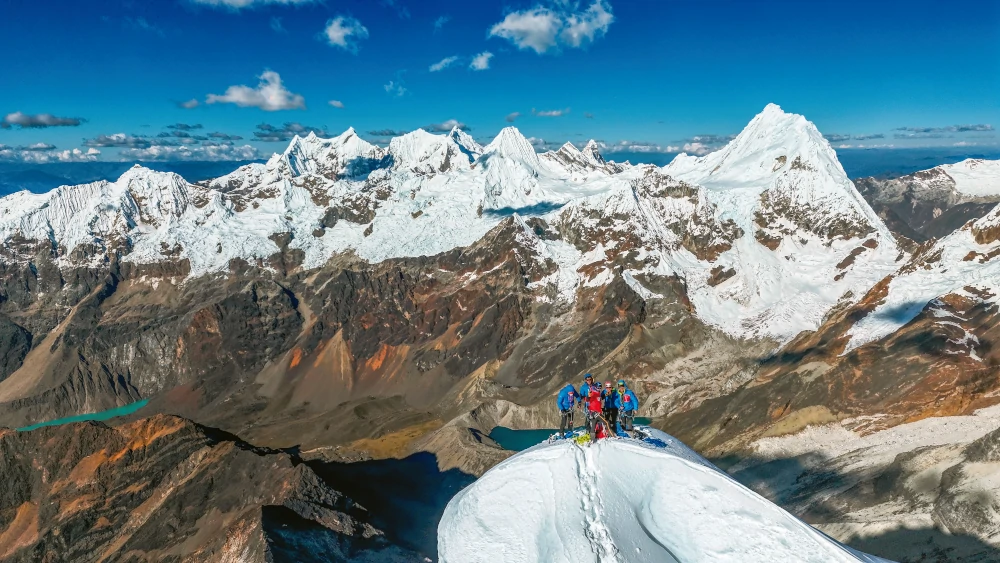
The Balearic Islands Mountaineering Advanced Training Group opens the Directíssima Mallorquina, a new climbing route reaching 5,800 metres in the Cordillera Blanca
No one had passed through there before, precisely the challenge they were looking for. Before them rose a daunting, untouched wall more than 520 metres high on the western face of an imposing mountain that stands majestically at 5,800 metres in the Cordillera Blanca of Peru. With great enthusiasm, a desire to put their training to the test, and a commitment to ascend by their own means, five Mallorcans reached the summit of Santa Cruz Chico last July after opening a new route, which they named Directíssima Mallorquina, graded MD+ (Very Difficult+).
A remarkable feat in a sport whose practitioners on the island could almost be counted on the fingers of both hands. All the more so given that the protagonists made up the first cohort of the Grup de Tecnificació d’Alpinisme de les Illes (Islands Alpine Training Group), promoted by the Federació Balear de Muntanyisme i Escalada (Federation of Mountaineering and Climbing). The team was composed of coordinators Cati Lladó (51) and Tomeu Rubí (49), alpinist Lluís Dietrich (27), and students Miquel Àngel Lorente (22) and Guillermo Anguera (21), both of whom come from sport climbing.
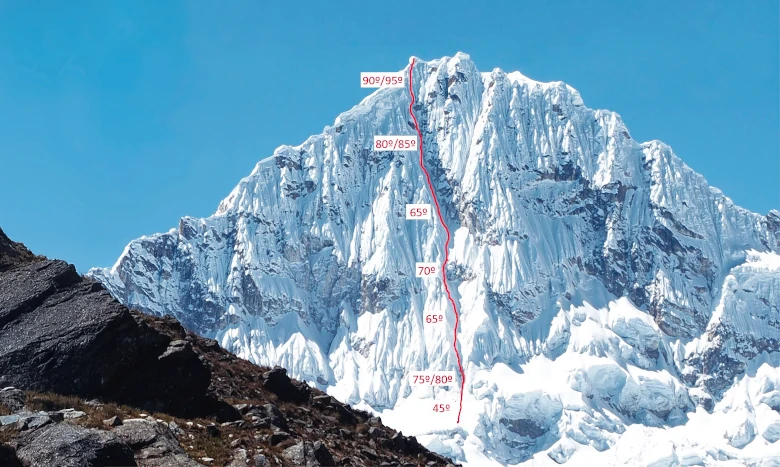
Route of the Directíssima Mallorquina on the west face of Santa Cruz Chico. Photo: FBME.
This adventure was the culmination of two years of intensive training on all kinds of terrain: rock climbs in Mallorca, winter activities in the Pyrenees and the Alps, and a trip to Norway to refine their ice-climbing skills. This is how the younger members learned “to be self-sufficient, to move with autonomy, not to engage in mountain tourism where everything is prepared. That’s like winning the Tour on an electric bike,” Rubí explains. Once in Peru, they completed their acclimatisation on Vallunaraju, Yanapaccha and Shacsha, three mountains of lower technical difficulty where they fully experienced the effects of altitude: headaches, dizziness and that feeling of “being ill all the time,” Lorente recalls. Part of a trade where “endurance and resilience matter more than physical strength,” he adds.
The summit push
At one in the morning, when the cold still bites and the body only wants to keep sleeping, the group took their first step towards a wall for which “we had barely any reference points and only a photo from Google Maps,” Rubí notes. Progress, slow and methodical in 50-metre rope teams, became more demanding as they gained height, especially on the final section, where “the powder snow forced us to crawl along, digging a sort of trench to keep ourselves going,” Lorente says.
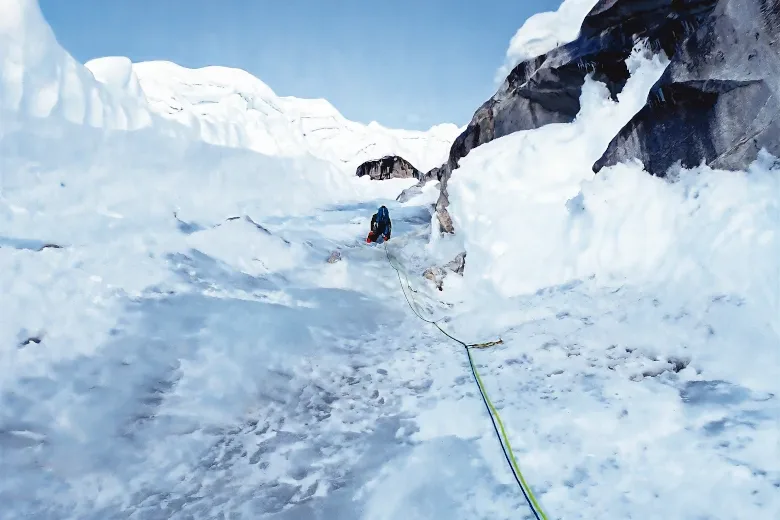
The ascent was carried out in 50-metre pitches, progressing almost vertically. Photo: FBME.
When they finally emerged onto the summit —a ridge so narrow that the five of them could scarcely fit— there was no euphoria, only restrained emotion. “You congratulate each other and shake hands, but not much more. Up there you’re already thinking about the descent; you still have half the journey left,” Lorente points out.
The descent, just as technical and demanding, was marked by abseils on ice and the very real risk of the rope getting stuck. Every manoeuvre required almost surgical calm. Finally, at half past eleven at night, they reached base camp, exhausted after more than 22 hours of uninterrupted activity on vertical terrain, with barely enough strength left even to eat.
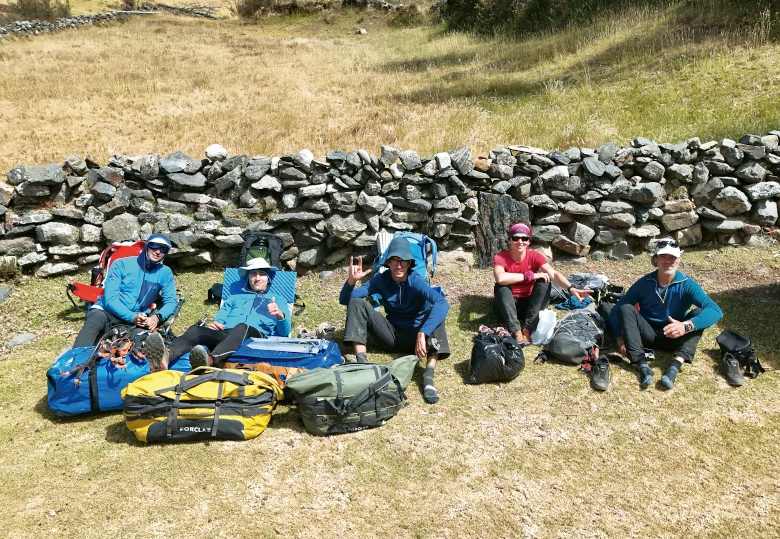
Lluís Dietrich, Miquel Àngel Lorente, Guillermo Anguera, Cati Lladó and Tomeu Rubí resting during one of the acclimatisation routes. Photo: FBME.
It was only once they were back home that they began to grasp the magnitude of what they had achieved: writing one of the most remarkable chapters in the island’s mountaineering history. “It was an excellent experience, and on top of that we were three times lucky: perfect weather, finding an untouched face, and it also being of a grade we could handle as a team… It was a gift,” Tomeu Rubí sums up. Their tracks have already disappeared, but the Directíssima Mallorquina will remain forever.





Leave A Comment