
Mallorca starts 2026 with a strong boost in the residential sector. According to the Economic Overview of the Balearic Islands, prepared by the Direcció General d’Economia i Estadística, approved housing units in Mallorca increased by 152% between January and February compared with the same period the previous year. Across the Balearic Islands, 1,404 approved housing units were recorded in the first two months of 2026, 109.9% more than in 2025.
The increase in approved housing units in Mallorca comes in a context of strong momentum in the construction sector in the Balearic Islands, consolidating the upward trend seen at the end of 2025. That year, 4,842 approved housing units were recorded, 29.8% more than in 2024 and the highest level since 2009.
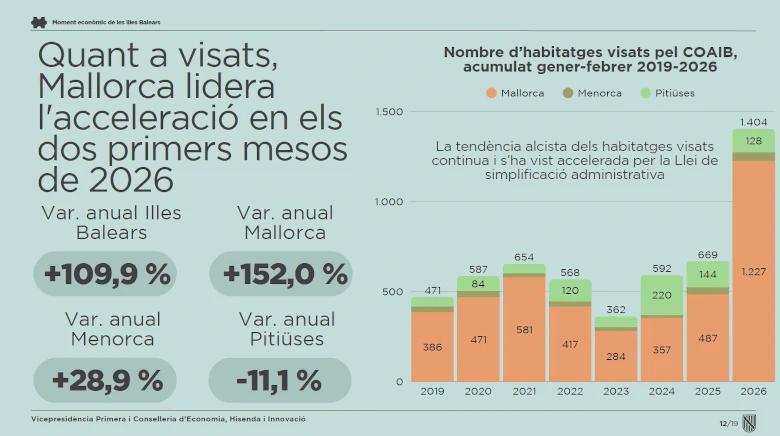
At the start of 2026, this trend intensified, partly as a result of the Law on Administrative Simplification and Rationalisation, which has helped to speed up procedures and reactivate residential projects, the Balearic Government reported in a statement.
Employment: record Social Security affiliation in the Balearic Islands
The labour market also continues to show a positive trend. In March, Social Security affiliation in the Balearic Islands grew by 3.2%, reaching 528,048 people, the highest figure on record.
The increase was recorded both in the general regime, with a rise of 3.4%, and among self-employed workers, who grew by 2.2%.
Tourism: fewer visitors, but higher spending
The tourism sector shows a more nuanced picture. During the first two months of the year, total spending rose by 2% to 627 million euros.
However, the number of tourists fell by 7.3% compared with 2025, with a sharper decline among international visitors (-8.4%) than among domestic visitors (-5.7%).
Despite this, average spending per person reached 1,051 euros, 10% more, while daily spending stood at 147 euros (+5.7%), pointing to a visitor profile with greater spending power.
Services: recovery in activity
The services sector recovered in February from the downturn recorded in January, driven by the momentum of professional and administrative activities.
Turnover grew by 4.4%, almost three times the national average, which stood at 1.6% over the same period.
Inflation: rise due to the geopolitical context
Price trends were affected by the international context. Instability caused by the conflict in the Middle East led to a rise in inflation in March, which reached 3.6% in the Balearic Islands, compared with 3.4% across Spain.
The rise in fuel prices was one of the main factors behind this increase, breaking the downward trend seen in previous months.






Leave A Comment