
The population of the Balearic Islands in 2026 reached 1,259,545 inhabitants as of 1 January, according to provisional data from the Continuous Population Statistics (ECP) published by the National Statistics Institute (INE). This figure represents an increase of 9,701 people compared with the same period a year earlier, when the population stood at 1,249,844 residents. In relative terms, annual growth is 0.78%, which confirms the archipelago’s upward demographic trend.
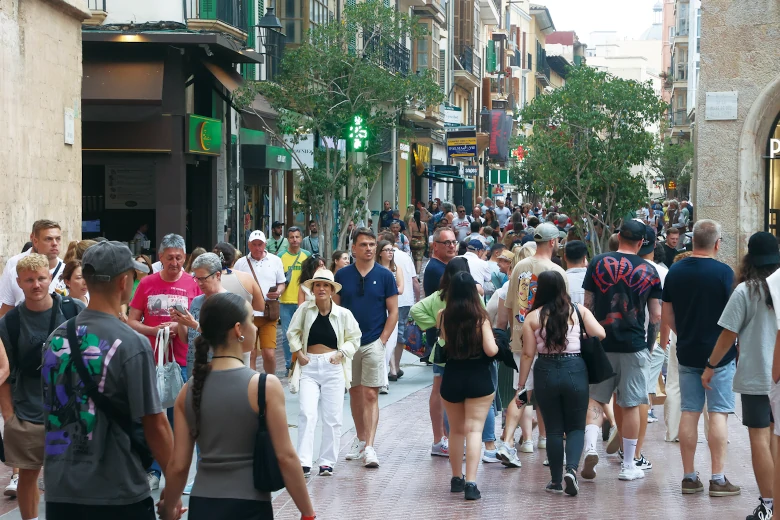
The breakdown by sex remains virtually balanced, with a slight female majority. Of the total residents, 627,219 are men (49.8%) and 632,326 are women (50.2%), a difference of just over five thousand women. Population growth is shared between both sexes, with a somewhat larger increase among women.
In terms of nationality, the population of the Balearic Islands in 2026 remains predominantly Spanish, although the foreign population continues to account for a significant share. Specifically, 274,331 residents are foreign nationals, representing 21.8% of the total, a proportion that has become structural in Balearic demography.
Age structure of the population of the Balearic Islands in 2026
The age structure of the population in the Balearic Islands shows a clear predominance of adult groups. The largest cohort is 45 to 59 years, which comprises 302,727 residents, representing 24.0% of the total. This is followed by the 30 to 44 years group, with 277,810 inhabitants (22.1%), and the 15 to 29 years group, with 221,472 people (17.6%).
At the extremes of the population pyramid, those under 15 number 162,871 residents (12.9%), while the 60 to 74 years population reaches 193,521 inhabitants (15.4%). Meanwhile, those aged 75 and over account for 101,144 people, equivalent to 8.0% of the Balearic population.
Demographic balance
The Continuous Population Statistics data reflect a demographic trajectory characterised by sustained growth in the number of residents and the predominant weight of adult age groups. The population structure remains balanced by sex, with a slight female majority, and a significant presence of foreign nationals within the archipelago as a whole.





Leave A Comment