
Bennàssar is one of the most unique Mallorcan artists of his generation. He has developed an easily recognisable pictorial and sculptural language. He welcomes us to his estate, a manifestation of Mallorca: a space dotted with sculptures and works that continue to be scattered throughout the island. With him, we reflect on the importance of breaking with the established, his return to his native island, and the influences that shaped his style.
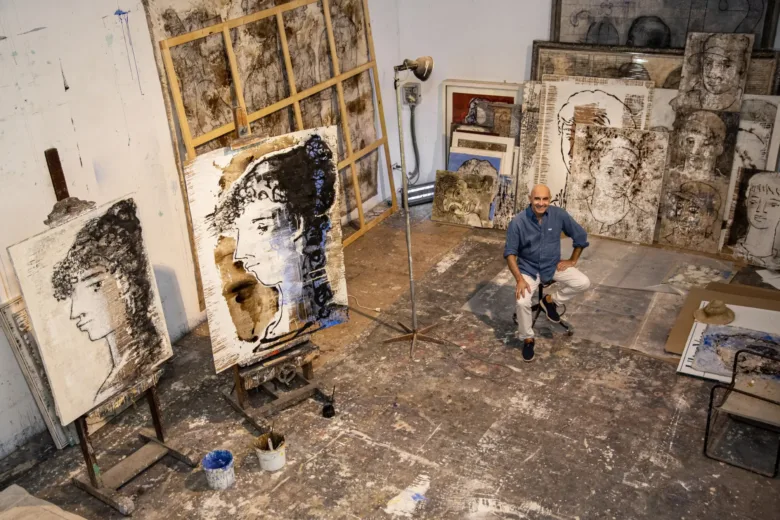
– How and when did your artistic career begin?
– I don’t know if it had a beginning, because from a young age, when I was 12, I was lucky enough to have my teacher, the painter Mateu Llobera, tell my father that I had artistic talent. At that time, he was working with the painter Simeón Cerdà, son of the legendary Llorenç Cerdà, so between them, they encouraged me to develop my painting skills and set me on the path to art.
– You devote yourself to both painting and sculpture. Which discipline do you feel more comfortable with? Which gives you more freedom?
– I have always been better known as a painter, but now I would say that I am better known as a sculptor, because sculpture has a physical presence that painting does not have. Nowadays, it is difficult to attract the public to art galleries. In fact, at the School of Arts and Crafts in Palma, I met the sculptor Jaume Mir, who guided me towards sculpture and modelling, and then at the School of Fine Arts in Barcelona.
At that time, I practised sculpture more in the summer, when I came to Mallorca, because I knew carpenters and blacksmiths who helped me and, ultimately, I had more space. Now that I live in Mallorca, let’s say that in the mornings I do sculpture and in the afternoons, painting. But I don’t know where I feel more comfortable.
I think the difference between the two disciplines is that sculpture is very material and, moreover, three-dimensional. A painting, on the other hand, is more fictional; it has an intangible magic with which you can create illusion within a square surface. And I play with both. Accuracy is never true. Apart from being a figurative painter, I have never wanted to be a painter who copies reality. Over the years, I have learned that there is no beauty without chance.
– When a project is born, how does it develop from the idea to the final result?
– I don’t allow for processes when I’m painting a picture because I create many and already have defined ideas; what I’m looking for is chance. That unexpected thing that I trust to lead me to the unexpected. My process is knowing how to look, seeing the emotions that what I’m doing produces in me.
My process comes from the work itself; I force myself, I have a schedule. This way, I manage not to be an artist of moments; I want inspiration to find me in the studio. I try to look at it a lot, not to settle.
I don’t follow sketches, I don’t like to close myself off; I set myself goals and enjoy looking for them. I like to go to sleep with open processes and wake up with the problems of the previous day.
– What role did Antoni Tàpies play during your time in Barcelona?
– I arrived in Barcelona in 1969 and already knew him as a painter through his works and books, but I was surprised by the poetry he brought to simple things and how he conveyed his inner life without needing to explain it realistically. He opened up a new world for me; with him, I discovered the inner life, being a very aggressive artist who spoke of the poverty of things. Similarly, Pablo Picasso was also a painter who captivated me with his work.
I travelled around Europe in the 1970s when I was very young, a time of great effervescence, freedom and movement. And Tàpies was a representative of the new and of something that had not yet reached Mallorca. During my years of study in Palma, it was an old city; feudal relationships existed that tourism eventually dissolved.
– Despite receiving the pictorial legacy of the Escola Pollencina, why did you not opt for landscape painting like most artists of this movement?
Fundamentally because a young person has to be accustomed to breaking with tradition, and at that time it is true that I did not get to know Anglada Camarasa, but I did know Dionís Bennàssar, Tito Cittadini… who did what was expected of them. But, in a way, young people have to be subversive and look for new things, not exactly continue with the established order. Now I am more satisfied with landscapes than I was back then.
The figure of Paul Cézanne, an artist who painted the same mountain many times, taught me that reality, regardless of what you have in front of you, is what you are capable of creating.
Part of my work needed a conceptual basis from which to draw things. I have done many self-portraits, I have played with travel and I have been interested in Mediterranean culture. I feel Mediterranean and Mallorcan, and I say Mallorcan because, being isolated, we have a very clear concept of territory and family, which gives us a way of looking at the horizon, searching for it without having convictions that cannot be moved.
– Where does the primitivism in your works come from? Who inspires you?
– It’s a matter of taste; I prefer searching to finding. It comes from the need to search: chance, knowledge… Primitivism because books like The Odyssey, The Iliad, Homer, even Greek or Roman philosophical thought… are books and ideas that still influence me today, and there have been few new thinkers who have generated this human diversity in me.
Humanity has lived in a centre, at least from my world, where the Mediterranean has been the cradle of knowledge. That is, a constant search for a utopia that does not exist. Eduardo Galeano commented that a utopia serves to walk and seek a goal. Primitive people, in their instinct for survival, found more animals and beasts beyond the horizon. Rising above and looking beyond is what truly gives you humanity.
– When someone sees one of your sculptures or paintings, they know it’s by Joan Bennàssar even before they see the signature. How did you achieve such a distinctive and characteristic style?
– It’s not something I really sought out, it just happened. My father was a labourer and I worked with him. I’ve actually made many sculptures with many materials, I even did a large bronze run until it became too expensive, and I discovered that I liked playing with what motivated me. They come from a poor background, but one that is deeply rooted in the territory.
Also, in the 1970s, at the Royal Academy of Arts in London, I saw the remains of Pompeii, an exhibition that completely moved me. And perhaps my works remind me of them and their humanity. It is a way of talking about man, an imperfect being who gets excited, with a history of search and discovery, like the Golden Fleece or the Holy Grail. I am inspired by the ship Argos, full of young men who are half human, half gods; contradictory Mediterranean gods to compensate for human weaknesses.
– What themes do your works address?
– I suppose I talk about oneself, one’s own search, love, family, friendship. As a man, I face the disasters of the world because life is wonderful.
– What role does the female figure play in your work? Beyond the beautiful and sensual point of view.
– I believe in matriarchy. I consider that the women close to me have always been very intelligent and have had more influence than it seems. Women in my work represent beauty and admiration. Ultimately, they are a testament to my love for the women who came before me. It is also very poetic, because deep down I am also talking about myself, how I see myself and what I desire.
– You have exhibited and participated in fairs all over the world. Where are you most satisfied with having taken your work?
– I have had two phases in my career. The first was more combative, exhibiting in galleries around the world, and the second was when I freed myself from the protector who safeguarded and guided me, and I removed myself from the galleries. In Mallorca, I found my place again. I loved exhibiting in China, America, Germany… but in recent years I’ve been doing things here, where I’ve sought out my audience. I’ve always tried to break away from the traditional channels and put on exhibitions that aren’t really for selling, but for showing.
– What projects do you have in the pipeline for next year?
– We are in negotiations to extend the exhibition period at the Castillo de San Carlos in Palma and we have a proposal on the table for a new exhibition that I hope will see the light of day soon.
– The earliest works featured on your website date from 1965-1970, and the most recent ones are from this year. Sixty years have passed between the two. How would you define the progress and course of your artistic career?
– I would say that I am more confident now. I have lost the youthful spirit of exploration and uncertainty because I now have a better idea of where I am going. But I have loved it; I feel fulfilled and I have been able to survive doing what I love most. When I have encountered contradictions, I have been able to overcome them. I have continued with my career, which is the important thing: not letting yourself be overtaken. Now I try to talk about new things.
The accessibility of images marked a radical change of era, which led me to limit myself in order to preserve my skills. When I look at my old paintings, they surprise me. I like what I do now better because of the fulfilment, determination and attempt to be more specific. In short, a change of era.




Leave A Comment