

The first reaction was disbelief. It seemed impossible that such a significant fact for the history of Mallorca, of Europe, and of Architecture could have gone unnoticed. I must have been mistaken, so I recalculated the figures from different angles. But the numbers were stubborn. Palma has fourteen churches in genuine early Gothic style, built between the thirteenth and fourteenth centuries. What I tried to verify again and again was that these churches – some of extraordinary architectural quality – made Palma the Spanish city with the highest number of Gothic churches. The next, Seville, has ten. Valencia follows with seven, and the rest – including Toledo, Barcelona, León, Burgos, Cuenca and Ávila – do not exceed six. For perspective, Palma has as many early Gothic churches as the four Catalan provincial capitals combined. Girona has three; Tarragona, four; Lleida, two. And to all these we must add those demolished in the nineteenth century after the Mendizábal decree. Palma lost five.
Research is always an adventure, and I dared to trace which European cities might surpass Palma’s figure. The starting point had to be Paris, home to gems such as St Denis, Notre Dame, Sainte-Chapelle, and also Saint Séverin, Saint Merri, Saint Nicolas, Saint Gervais, Saint Julien, Saint Medard, Saint Germain-l’Auxerrois and Saint Leu-Gilles. Paris also suffered demolitions during nineteenth-century reforms, yet ten early Gothic churches remain. Palma’s lead held. I continued exploring other European cities: Venice, Florence, Genoa, Milan, Bologna, Naples, Prague, Krakow, Erfurt, Cologne, Lübeck, Gdańsk, Bruges, Nantes, Palermo, Chartres and London. None had more than seven. Palma and Paris were, for the moment, the two European cities with the largest number of genuine early Gothic churches.
But what was happening in Mallorca in the thirteenth and fourteenth centuries for Palma to experience such a flourishing of Gothic architecture? In my view, the explanation lies in the fortunate convergence of three circumstances: one economic, one political and one cultural.
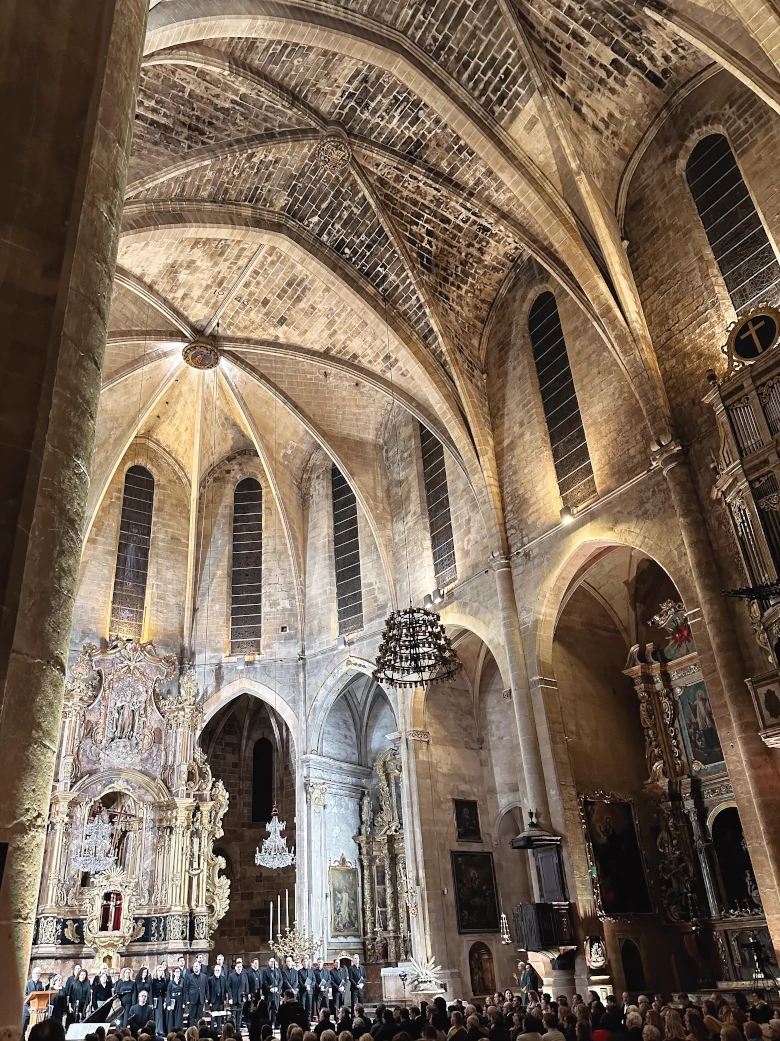
Spectacular image of the Church of Santa Creu during a choral concert. Photo: Carlos García-Delgado Segués.
Before the conquest of 1229, Palma – Medina Mayurqa – was one of the largest cities in Al-Andalus. Córdoba, Seville, Granada, Toledo and Palma were surpassed in Europe only by cities such as Constantinople, Paris or Venice. Palma had grown over three centuries of Muslim rule (10th–12th centuries) and was three times the size of Barcelona. Its strategic position allowed it to control trade between France and Africa, and between the Iberian Peninsula and Italy. Piracy and privateering stimulated the economy during the thirteenth and fourteenth centuries. Proof of this economic boom is the enormous lonja built in Palma at the beginning of the fifteenth century, a sublime example of civil Gothic architecture designed by Guillem Sagrera.
To economic prosperity we must add the political context. Mallorca had been an independent kingdom from the fall of the Caliphate of Córdoba (1031) until 1229, and once again independent – this time with its capital in Perpignan – from the death of Jaume I in 1276 until 1343, when it was reintegrated manu militari into the Crown of Aragon. One revealing fact lies in the dates when Palma’s Gothic churches were begun: Cathedral, 1230; Temple, 1230; Santa Eulalia, 1230; Santa Margalida, 1236; Santo Domingo (demolished), 1245; Santa Clara, 1256; Sant Francesc, 1281; Sant Miquel, 1290; Santa Aina, 1300; Sant Nicolau, 1302; Santa Fe, 1315; Sant Jaume, 1327; Santa Creu, 1335; Sant Bartomeu, 1340; La Sang, 1487. With one exception, all fall between the conquest of 1229 and the end of the independent kingdom in 1343. Little more than a century. Another telling detail: most are earlier than the main churches of Barcelona, whose cathedral was not begun until 1298, sixty-eight years after Palma’s. Santa Maria del Pi followed in 1322, and Santa Maria del Mar in 1329.
Finally, a cultural factor: Gothic architecture is highly rational and was promoted by the French Cistercian monasteries in parallel – and not by coincidence – with scholastic philosophy, which sought to reconcile reason and faith. Coinciding with this Gothic flourishing, Palma was the birthplace and home of a singular Mallorcan scholastic thinker and universal philosopher, Ramon Llull, who served as tutor to the forward-thinking King Jaume II, much as Aristotle had been to Alexander. At that time, the Kingdom of Mallorca held much of its territory in what is today France – Roussillon, Cerdanya and Montpellier – with its capital in Perpignan. It is therefore unsurprising that, with two monarchs – Jaume I and Jaume II – born in Montpellier and endowed with notable cultural curiosity, the Kingdom of Mallorca became a spearhead of Gothic architecture in Europe.









Leave A Comment