
Mallorca could face a regression of between 7 and 50 metres on several of its beaches in the coming years, which would mean a loss of 9% of the surface area of the island’s sandy shores. This is one of the main conclusions of the report produced by GLOVAL Building Value and presented during the IV Sustainability Conference in Mallorca Hotels, organised by ECO-ONE at the Real Club Náutico de Palma.
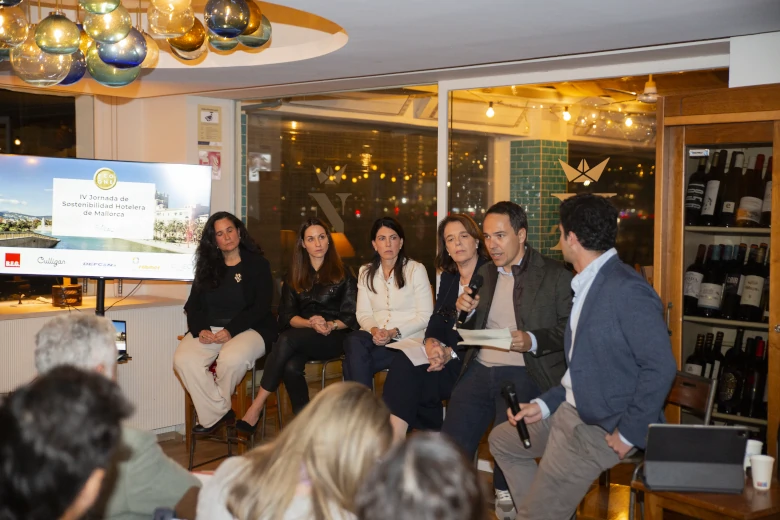
The IV Sustainability Conference in Mallorca Hotels addressed environmental challenges and the strategies of the tourism sector. Photo: ECO-ONE.
The analysis, presented by Joaquín Elízaga, CFO of GLOVAL, also warns that 144 hotels are located in flood-prone areas, whether due to marine or river risks, placing the sector in a scenario of notable vulnerability in the face of climate change.
Sustainability and economic growth
The conference was opened by Catalina Barceló Horrach, Director General of Economy and Statistics, who recalled that the islands continue to break tourism records month after month and highlighted the importance of steering public policies towards “a sustainable and competitive tourism system, one that respects the resources which support our social and territorial wellbeing”.
Indeed, the GLOVAL report confirms significant economic momentum: Mallorca’s GDP is growing by 4%, with occupancy at 86–87% and a tourism GVA that has doubled to €7.712 billion. Even so, seasonality remains a challenge.
Hotel sector strategies
The CEO of ECO-ONE, Carlos Fluixá, explained several initiatives aimed at improving circularity in hotels and raising guest awareness. He highlighted a practical case in which, instead of treating removed furniture as waste during a hotel renovation, ECO-ONE managed to sell 100% of the items, turning an expected expense into a revenue opportunity.
The subsequent panel discussion examined how major hotel chains are adapting to climate risks and the need to operate more sustainably.
Meliá Hotels International, represented by Lourdes Ripoll, presented its “Travel for Good” strategy, a framework that integrates its environmental, social and governance policies. This strategic vision, developed over more than two decades, has positioned the company as the most sustainable hotel group in Europe. Ripoll emphasised that climate change is a key factor in decision-making and that sustainability is applied across all areas of the company.
Iberostar Hotels & Resorts, represented by Paloma Carrillo de Albornoz, detailed the “Wave of Change” programme, focused on reducing plastics, promoting circular economy models and protecting the oceans. She explained the actions already implemented in Alcúdia and Platja de Muro, ranging from dune restoration to circular waste management projects and coastal vulnerability assessments.
Operations and regulatory adaptation
In the second part of the panel, BLUESEA Hotels and Fergus Group focused on operations and regulatory adaptation. Lara Magro from BLUESEA noted that Mallorca acts as a regulatory testing ground: the island’s requirements allow them to develop standards that are later replicated in other destinations, improving their procedures in terms of quality and sustainability.
For her part, Cristina Salmerón, CMO of Fergus Group, explained how their business model – centred on repositioning hotels in mature destinations – allows them to breathe new life into declining establishments. She detailed concrete ESG actions, such as eliminating single-use plastics, improving energy efficiency in all refurbishments, and implementing training and inclusion programmes to address seasonality.
The conference was closed by Pedro Homar, Executive Director of the Fundación 365, who highlighted the value of public–private collaboration in consolidating Mallorca as an international tourism benchmark.




Leave A Comment