
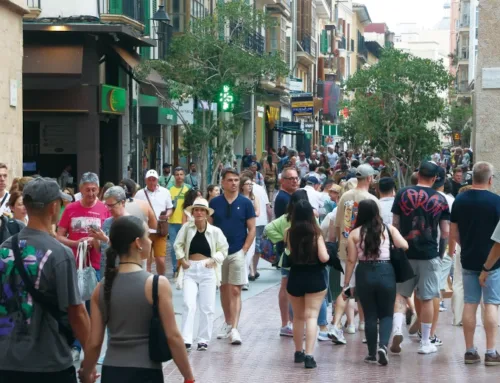
The retail sector in the Balearic Islands continues to gain momentum in 2025 thanks to the strong boost from tourist spending. According to the latest report from the Observatori del Comerç corresponding to the third quarter of the year, visitors have already spent more than 1.911 billion euros in the archipelago’s shops so far this year. This represents growth of 9.1% compared with the same period last year.

Between July and September alone, tourist spending in shops, supermarkets and other retail establishments reached 1.104 billion, an increase of 8.9% compared with 2024.
In total, sales in the Balearic retail sector show cumulative growth of 4.6% in 2025, exceeding the Spanish average (4.0%). The growth affects all sales categories and confirms the strength of both local and tourist consumption.
Employment in retail breaks records… except in Eivissa
The retail sector is also boosting employment. In October 2025, the number of workers reached 53,830 employees, 2.9% more than in 2024 and the highest figure in the historical series for the month of October. This is a much greater increase than that recorded across Spain as a whole, where retail employment rose by just 0.8%.
Mallorca, Menorca and Formentera are leading this growth with record affiliation numbers. However, Eivissa is experiencing a 3.3% decline, returning to 2019 levels.
E-commerce: more sales, but fewer companies
The Observatori also analyses the evolution of e-commerce in companies with ten or more employees. In 2025, 39% of these companies sold online, generating 580 million euros, which represents 8.2% of the sector’s total sales.
Although this percentage of digital businesses is lower than the Spanish average (43.6%), the volume of online turnover in the Balearic Islands remains significantly higher than the national average. Nevertheless, the report notes a decline compared with 2023, breaking the upward trend that began in 2019.
Even so, the share of electronic sales over the total improves from 7% to 8.2%, although it remains below the national average, which falls from 17.6% to 15.8%.







Leave A Comment