
The agricultural sector of Mallorca has the potential to cut up to 16% of its greenhouse gas emissions within five years, according to a study promoted by Mallorca Rural. The report, co-financed by FEADER funds, the Ministry of Agriculture and the Department of Agriculture, Fisheries and the Natural Environment of the Government, analyses the carbon footprint of 30 farms representing different production models across the island.
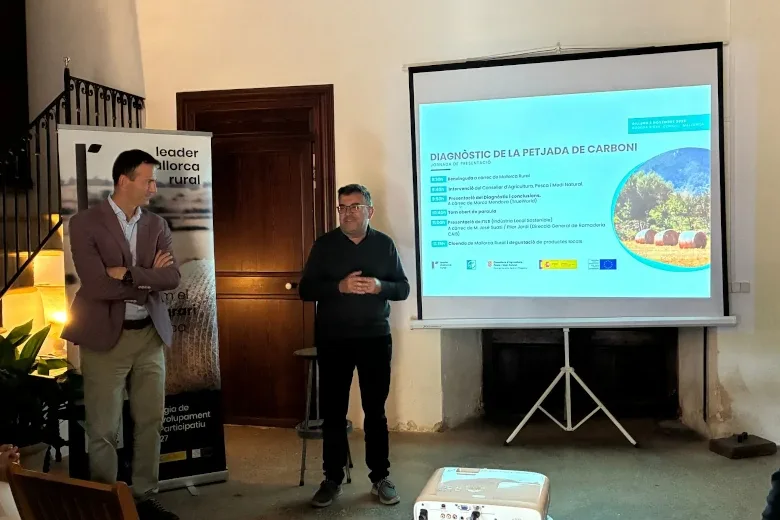
The vice-president of Mallorca Rural, Jordi Mora, and the Minister of Agriculture, Fisheries and Natural Environment, Joan Simonet, during the presentation of the study. Photo: CAIB.
The report identifies agricultural machinery as the main source of emissions, followed by the use of refrigerants, livestock and phytosanitary products. Nevertheless, the Balearic agricultural sector only produces 2.8% of the total emissions in the Balearic Islands, while managing more than half of the non-urbanised land and playing an essential role in the protection of the landscape, food sovereignty and the fight against desertification.
Measures to reduce emissions
Among the most effective actions to reduce emissions in Mallorca’s agricultural sector are improvements in energy efficiency, better management of fertilisers and manure and the implementation of renewable energies. The study also highlights the potential of regenerative agriculture and the capacity of agricultural land to act as a carbon sink, opening up new opportunities for the offsetting of emissions from other economic sectors on the island.
The agricultural sector of Mallorca, part of the climate solution
The Minister of Agriculture, Fisheries and Natural Environment, Joan Simonet, stressed that the primary sector is part of the climate solution. “Our farms contribute very little to emissions, yet they play a crucial role in protecting the land and ensuring local food supply,” he said. Simonet announced that the Government will continue to support farmers and livestock producers in the energy and technological transition, with grants for more efficient machinery, renewable self-consumption and sustainable production.
For his part, the vice-president of Mallorca Rural, Jordi Mora, underlined the usefulness of the diagnosis as a foundation for future investment. “Mallorcan farms are already moving towards sustainability. We now have a solid technical base to keep progressing and generate value through circularity and environmental enhancement,” he stated.



Leave A Comment