
The economy of the Balearic Islands remains strong and continues to stand out above the European average. According to the Economic Situation Analysis of the Balearic Islands, the archipelago’s GDP grew by 3.2% in the second quarter of 2025 — double the average for the European Union (1.6%) and above the figure for Spain (2.8%).
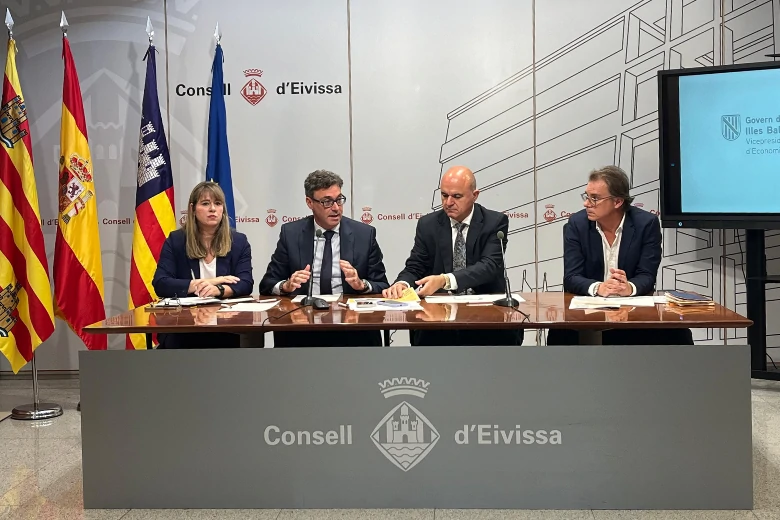
The Director General of Economy and Statistics, Catalina Barceló; the First Vice-President of the Government of the Balearic Islands, Antoni Costa; the President of the Consell d’Eivissa, Vicent Marí; and the Island Councillor for Presidency, Economic Management and Sports, Salvador Llosa, during the presentation of the economic report. Photo: CAIB.
This marks the sixth consecutive quarter in which the Balearic Islands have recorded growth above 3%. All the islands show significant progress: Mallorca leads with 3.2%, followed by Eivissa and Formentera (3.0%), while Menorca grew by 2.1%.
The report was presented in Eivissa by the First Vice-President of the Government, Antoni Costa, and the Director General of Economy and Statistics, Catalina Barceló. Costa emphasised that “all sectors are growing strongly”, although with slight moderation compared to last year.
The services sector continues to be the driving force of the economy, with growth of 3.3%, followed by construction (2.3%), industry (2.0%) and the primary sector (0.7%).
Employment also reflects this positive trend. In September, there were 639,122 registered workers, 2.6% more than in 2024. Most of the new jobs were created in the services sector (88%), with 14,202 more affiliates, followed by construction (+1,460) and industry (+544).
Balearic Islands break all tourism records
In the tourism sector, the report highlights that the Balearic Islands once again surpassed all records. Tourist expenditure up to August reached €17.36 billion (+5.6%), with an average daily spend of €202 (+5.4%) and an average spend per person of €1,233 (+3.1%). Costa stressed that “the islands are growing twice as much in value as in volume” and that “this is the path to follow”.
The number of tourists reached 14.1 million (+2.4%) up to August. Menorca (5.5%) and Mallorca (2.6%) led the increase, while Eivissa and Formentera grew by just 0.1%. However, the Pitiüses stood out for the increase in average expenditure per person (+4.0%) and daily expenditure (+13.2%).
Overnight stays amounted to 86.1 million, with a slight decline of 1.4% during the peak season months, offset by an increase of 3.3% between January and May. The average length of stay fell from 6.2 to 6.1 days.
Despite the positive results, the report also warns about inflation, one of the highest in the country. In September, the Balearic Islands recorded 3.3%, compared with the 3.0% national average. Core inflation stood at 2.8%, also higher than Spain’s 2.4%.




Leave A Comment