
The report commissioned by the platform Mallorca per Viure, no per especular (Mallorca to Live In, Not to Speculate) warns that the new land law could allow demographic growth of 37% in the seven most populated municipalities of the island
The approval of Law 4/2025 on urgent actions for the acquisition of land has generated intense debate in Mallorca. The regulation, promoted by the regional government with the aim of expanding the housing supply, opens the door to reclassifying 1,246 hectares of Transition Areas (AT) —rural land designed to curb urban sprawl and reserve space for infrastructure— for residential use, according to a study led by geographer Gabriel Garcies and commissioned by the platform Mallorca per Viure, no per especular.
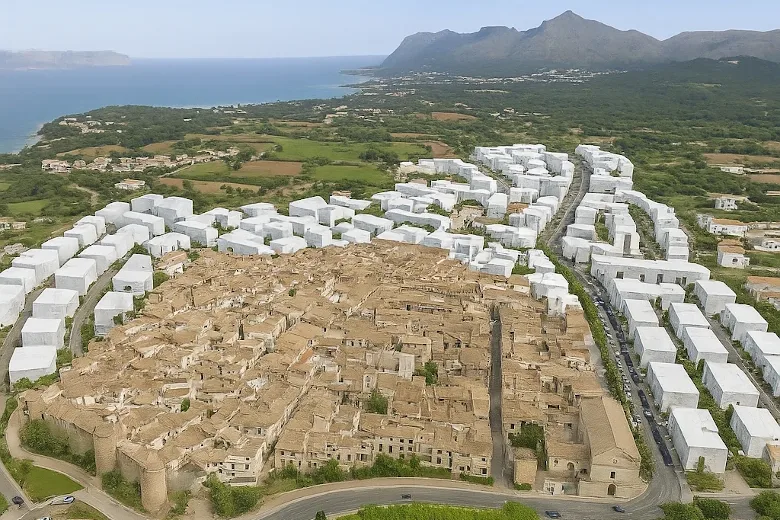
Simulation of the increase in residential capacity in the municipality of Alcúdia. Source: Platform Mallorca per Viure, no per especular.
The report, entitled Mapa de l’especulació (Map of Speculation), states that the implementation of the law could result in the construction of 252,810 new residential places in seven municipalities with more than 20,000 inhabitants: Palma, Llucmajor, Manacor, Inca, Marratxí, Calvià and Alcúdia. The study estimates that this potential growth represents a 37% increase in the current population compared with the 2024 census.
Palma would be the municipality most affected: 634 hectares of rural land would become urbanisable, representing a 15% increase in urbanisable surface and a 33% rise in population, with capacity for 142,650 new residential places.
Other projected growths include:
- Marratxí: 27,180 residential places (+68% population) in 151 hectares (+13% urbanisable surface).
- Manacor: 24,480 places (+51%) in 136 hectares (+12%).
- Calvià: 21,240 places (+39%) in 118 hectares (+5%).
- Llucmajor: 16,200 places (+41%) in 90 hectares (+9%).
- Alcúdia: 12,600 places (+57%) in 70 hectares (+11%).
- Inca: 8,460 places (+24%) in 47 hectares (+12%).
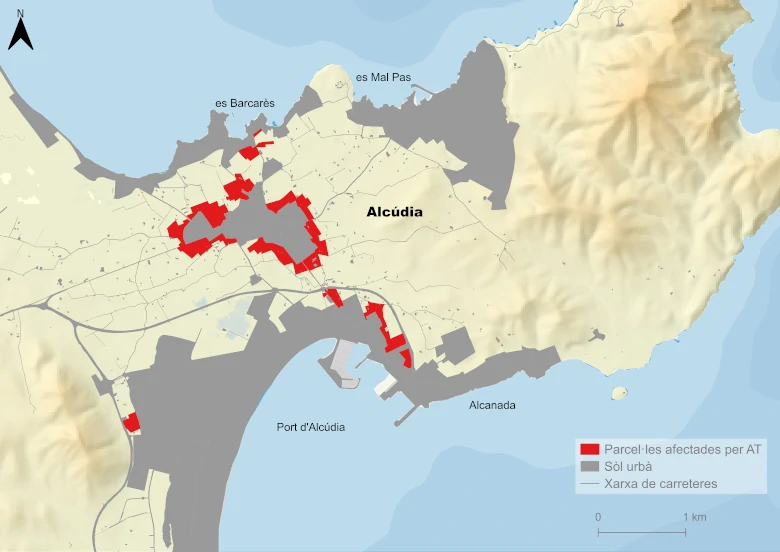
Transition areas in Alcúdia. Source: Platform Mallorca per Viure, no per especular.
The law also sets population densities of up to 225 inhabitants per hectare in Palma and 180 in the rest of the municipalities.
Free-market and reduced-price housing, but without social protection
The same report underlines that 50% of the planned homes would be free-market and the rest reduced-price, but none would be officially protected housing. According to the experts’ calculations, this would mean flats of around 80 m² at a minimum of €300,000, which —in the view of the platform promoting the study— would not solve the housing access problem for young people or low-income families: “Not a single flat is designed for affordable or controlled rents. This means that those who are already struggling to buy or rent will remain in the same situation. The only outcome will be an increase in population, with people able to afford these prices coming from outside, or speculators buying them as investments.”
Environmental organisations such as GOB have also expressed concern about the pressure that this growth could place on water resources. They recall that the 2023 Water Resources report had already warned of the lack of available water for urban development in Palma, the city that concentrates much of the potential growth foreseen in the law.
“Demographic time bomb”
The authors of the Mapa de l’especulació finally warn that neither the regional government nor the affected municipalities have provided official figures on the hectares involved, the number of housing units, or the demographic and environmental impact, and describe the regulation as a true “demographic time bomb” on an island already strained by a lack of resources. “The government approved this law under the pretext of creating more ‘social housing’. The reality, however, is that it is a gift to the big property developers,” the platform said in a statement.




Leave A Comment