
The 112 Illes Balears Emergency Coordination Centre today marks its 30th anniversary, firmly established as one of the essential pillars of the Balearic Islands’ security and emergency system. Since it was launched in February 1996, the service has handled more than 24.5 million calls and managed almost 4 million incidents (3.97 million), figures that reflect the scale of an operation that has run uninterrupted since day one.
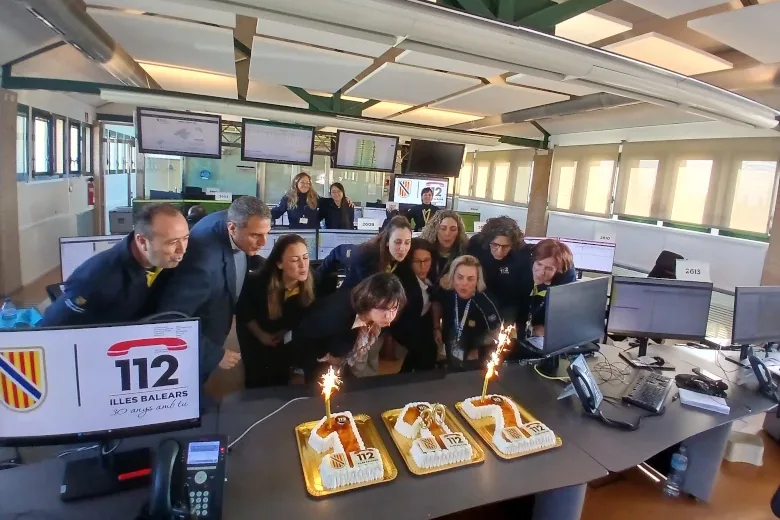
Part of the 112 Illes Balears team celebrates the 30th anniversary at the emergency centre’s headquarters. Photo: CAIB.
The Balearic Islands were not only among the first regions to implement this model: the Balearic 112 was the first to come into operation in Spain, even ahead of the 1997 Royal Decree that developed the 1991 European directive recommending the rollout of this single emergency number across Europe.
112 Illes Balears: a pioneering service that began in Palma
The project started under private management with a modest structure. The first operations centre was located on Palma’s Passeig Marítim, with an initial workforce of just 12 professionals. However, rising demand and the consolidation of the model meant the team grew quickly: by 1998 there were 30 staff and by 2002, 42.
A major turning point came in 2005, when the Government of the Balearic Islands took direct control of the service through the creation of the public company Gestió d’Emergències de les Illes Balears (GEIB). This change brought a structural and technological transformation of the centre, as well as its move to the current headquarters at El Pinaret (Marratxí), where around a hundred professionals now work.
Since then, 112 Illes Balears has evolved towards an increasingly technology-driven model, focused on comprehensive coordination among all response bodies: medical emergency services, firefighters, police forces and rescue services.
Intense activity for 112 Illes Balears in 2025
Beyond the historical milestone, the 2025 operational figures once again highlight the heavy workload managed by the centre.
Over the past year, 112 Illes Balears handled 785,093 incoming calls and coordinated 143,314 incidents, translating into a daily average of 2,148 calls and 393 emergencies managed. In practice, the centre operated at close to 400 incidents a day, a figure that reflects the service’s constant activity.
The most common types of intervention were led by medical emergencies, alongside medical queries, road traffic accidents, public-order incidents and domestic accidents. Medical emergencies at home and in public spaces account for a significant share of activations.
Mallorca accounts for the greatest demand
The territorial distribution of incidents maintained a direct relationship with population levels and tourist activity. Mallorca recorded the highest demand, with 113,159 incidents, followed by Ibiza (21,341), Menorca (7,166) and Formentera (1,618).
As is often the case, seasonality once again set the pace of operations. The summer months saw the highest call peaks, with July and August exceeding 90,000 calls per month, while volumes remained more moderate during the winter.
Improved efficiency and more precise location
One of the most positive indicators in 2025 was the significant reduction in non-actionable calls, which fell to 122,447 communications, compared with considerably higher figures the previous year. Most of these calls were linked to misdials or technical network issues.
There was also a notable improvement in location accuracy thanks to AML (Advanced Mobile Location) technology. In 2025, 71% of calls made from national mobile networks could be located using this system, a marked increase compared with 57% recorded in 2024. This progress represents a key improvement in the speed and effectiveness of the response, especially in serious emergencies where every second matters.
Psychological support in critical emergencies
The psychosocial component remains an essential part of the emergency response set-up.
-
267 activations of emergency psychologists in 2025
These interventions take place in particularly sensitive situations for victims and their families.
More incidents despite fewer calls
Year-on-year trends show a noteworthy dynamic:
✔️ A decrease in overall call volume.
✔️ An increase in operational workload.
Change compared with 2024:
-
📞 Fewer incoming calls.
-
🚨 +7,160 incidents managed.
Operational reading:
-
Greater complexity of emergencies.
-
Greater need to mobilise resources.
-
Overall improvement in system efficiency.






Leave A Comment